

 PDF version
Leader
co-leader
Timing and Structure
Thursdays 11-1pm, and Mondays 9-11am plus afternoons.
Prerequisites
None
Aims
The aims of the course are to:
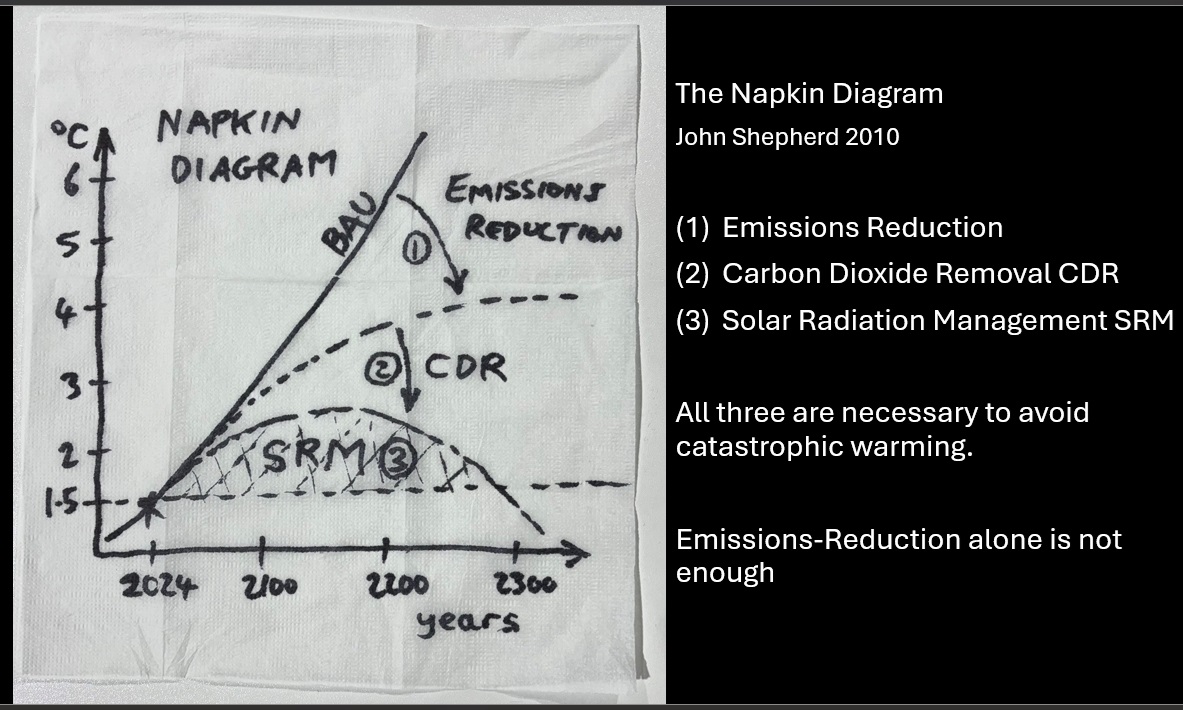
- understand the timelines and stresses that we're facing as a result of climate change, and guided by The Napkin Diagram explore the options available to avert excessive global warming and arctic melting.
- explore the literature of some of the Climate Repair techniques available and compare them in terms of their impacts, costs, scalability and social acceptability.
- take one particular option for Climate Repair and carry out a detailed quantitative analysis and to perform a public consultation exercise. Together these might be used to guide policy makers.
Objectives
As specific objectives, by the end of the course students should be able to:
- To explore the options for Climate Repair given that mitigation (ie Emissions reduction alone) is no longer sufficient to prevent irreversible changes to the climate, for instance melting of polar sea ice
Content
Climate change presents us with many challenges. Mitigation (ie Emissions reduction alone) is no longer sufficient to prevent irreversible changes to the climate, for instance melting of polar sea ice.
Negative emissions (Carbon Dioxide Removal CDR) is necessary but it too is not sufficient to deal with climate change in the short term. Interventions known as "geoengineering" are likely to be necessary. These include Solar Radiation Management (SRM) which is about enhancing the Earth's albedo - reflecting more light.
The two most researched options are "Stratospheric Aerosol Injection" (SAI) and "Marine Cloud Brightening" (MCB). The purpose of SRM is to keep temperatures low enough to prevent catastrophic climate change and to avoid irreversible tipping points. It will "buy time" so that Mitigation and CDR will be given time to be implemented and to take effect.
FORMAT
Further notes
The NOAA website gives good background on SRM
https://www.climate.gov/news-features/understanding-climate/solar-radiat...
Also see the "Napkin Diagram"
https://www3.eng.cam.ac.uk/~hemh1/climate/napkindiagram.jpg
Coursework
| Coursework | Due date | Marks |
|---|---|---|
|
First Individual report |
end week 1 |
15 |
|
|
|
|
|
Second individual report |
end week 2 |
15 |
|
Second report individual + team |
final report |
40 = 20+20 |
Examination Guidelines
Please refer to Form & conduct of the examinations.
Last modified: 11/11/2025 10:06