Undergraduate Teaching 2025-26

Not logged in. More information may be available... Login via Raven / direct.

Engineering Tripos Part IIA Project, GA1: Advanced-cycle Power Generation, 2018-19

Leader

Dr T P Hynes

Timing and Structure

Thursdays 11-1pm, and Mondays 9-11am plus afternoons

Prerequisites

3A5 Strongly recommended

Aims

The aims of the course are to:

  • Appreciate the thermodynamic engineering and economic principles, and the environmental impact, of power generation using combined gas turbine and steam cycles, and other advanced cycles
  • To use cycle analysis computer codes to perform parametric studies of various types of cycle in a variety of economic scenarios and ultimately to select, design and optimise a power plant for a specified operational role.

Content

The past two decades have seen a technical revolution in the power generation industry. This has been driven by rapid developments in gas turbine technology, the large-scale use worldwide of natural gas as a fuel, and the increased level of awareness concerning the consequences of environmental pollution. Since the early 1990s, thermal efficiencies of the best power stations have risen from 40% to 55% and are now approaching an astonishing 60%. These very high efficiencies are usually achieved by using a gas turbine to top a steam cycle, the so-called combined-cycle power plant.

However, cycle analysis is currently an extremely active area of research, with many new and novel cycles being proposed. Examples include gas turbine cycles with water or steam injection, cycles incorporating fuel cells, and cycles exploiting coal gasification. Some of these cycles promise extremely impressive thermodynamic performance, often at considerably lower capital cost than the combined-cycle.

In this project you will in teams of three undertake a computer-based investigation of combined-cycles and some of the above-mentioned advanced cycles, using a suite of especially written computer programs. (The analysis programs are written in FORTRAN, but a knowledge of this language is not required: for the most part you will use the programs with no or little modification. Some of the visualisation programs are written in Matlab code with which you should be familiar from Part I.) Cycle analysis and design is a complex procedure requiring comparatively elaborate calculations and it is virtually impossible to perform even the simplest design-point optimisation without the help of such programs. However, the project is structured in such a fashion that you should develop a firm understanding of the thermodynamic principles that underpin the operation of power generating plant. This understanding is essential to the innovation of new power generating cycles.


Computer investigation of simple cycles. Appreciation of thermodynamic principles (including second law exergy analysis) and environmental impact via parametric studies of (i) the steam cycle with reheat and feedheating, (ii) the combustion process, and (iii) the gas turbine with reheat, intercooling and heat exchange, considering multiple figures of merit (efficiency, specific work, cost of electricity) in multiple economic scenarios.

Assessment of different configurations of combined-cycle plant. Computer analysis of the single pressure, exhaust-gas heated combined cycle. Investigation of the effects of different fuels (on cycle efficiency and atmospheric pollution), feedheating, preheating loops, multi-pressure steam generation, gas and steam turbine reheat, etc. Again, multiple figures of merit and economic scenarios will be considered.

Assessment of different configurations of advanced-cycle power plant. A choice of cycles will be available at this stage. Between you, your team will investigate the performance attributes of a number of these cycles in the same contexts as the previous investigations.

Further notes

Examples papers

Coursework

Coursework Due date Marks

First Individual report

Thursday 16 May 2019

20

First team report

Thursday 23 May 2019

20

Second individual report

Thursday 30 May 2019

20

Second team report

4pm Thursday 6 June 2019

20


Booklists

Examination Guidelines

Please refer to Form & conduct of the examinations.

 
Last modified: 03/10/2018 10:13

Engineering Tripos Part IIA Project, GA1: Advanced-cycle Power Generation, 2017-18

Leader

Dr T P Hynes

Timing and Structure

Thursdays 11-1pm, and Mondays 9-11am plus afternoons

Prerequisites

3A5 Strongly recommended

Aims

The aims of the course are to:

  • Appreciate the thermodynamic engineering and economic principles, and the environmental impact, of power generation using combined gas turbine and steam cycles, and other advanced cycles
  • To use cycle analysis computer codes to perform parametric studies of various types of cycle in a variety of economic scenarios and ultimately to select, design and optimise a power plant for a specified operational role.

Content

The past two decades have seen a technical revolution in the power generation industry. This has been driven by rapid developments in gas turbine technology, the large-scale use worldwide of natural gas as a fuel, and the increased level of awareness concerning the consequences of environmental pollution. Since the early 1990s, thermal efficiencies of the best power stations have risen from 40% to 55% and are now approaching an astonishing 60%. These very high efficiencies are usually achieved by using a gas turbine to top a steam cycle, the so-called combined-cycle power plant.

However, cycle analysis is currently an extremely active area of research, with many new and novel cycles being proposed. Examples include gas turbine cycles with water or steam injection, cycles incorporating fuel cells, and cycles exploiting coal gasification. Some of these cycles promise extremely impressive thermodynamic performance, often at considerably lower capital cost than the combined-cycle.

In this project you will in teams of three undertake a computer-based investigation of combined-cycles and some of the above-mentioned advanced cycles, using a suite of especially written computer programs. (The analysis programs are written in FORTRAN, but a knowledge of this language is not required: for the most part you will use the programs with no or little modification. Some of the visualisation programs are written in Matlab code with which you should be familiar from Part I.) Cycle analysis and design is a complex procedure requiring comparatively elaborate calculations and it is virtually impossible to perform even the simplest design-point optimisation without the help of such programs. However, the project is structured in such a fashion that you should develop a firm understanding of the thermodynamic principles that underpin the operation of power generating plant. This understanding is essential to the innovation of new power generating cycles.


Computer investigation of simple cycles. Appreciation of thermodynamic principles (including second law exergy analysis) and environmental impact via parametric studies of (i) the steam cycle with reheat and feedheating, (ii) the combustion process, and (iii) the gas turbine with reheat, intercooling and heat exchange, considering multiple figures of merit (efficiency, specific work, cost of electricity) in multiple economic scenarios.

Assessment of different configurations of combined-cycle plant. Computer analysis of the single pressure, exhaust-gas heated combined cycle. Investigation of the effects of different fuels (on cycle efficiency and atmospheric pollution), feedheating, preheating loops, multi-pressure steam generation, gas and steam turbine reheat, etc. Again, multiple figures of merit and economic scenarios will be considered.

Assessment of different configurations of advanced-cycle power plant. A choice of cycles will be available at this stage. Between you, your team will investigate the performance attributes of a number of these cycles in the same contexts as the previous investigations.

Further notes

Examples papers

Coursework

Coursework Due date Marks

First Individual report

Thursday 17 May 2018

20

First team report

Thursday 24 May 2018

20

Second individual report

Thursday 31 May 2018

20

Second team report

4pm Thursday 7 June 2018

20


Booklists

Examination Guidelines

Please refer to Form & conduct of the examinations.

 
Last modified: 22/03/2018 14:03

Engineering Tripos Part IIB, 4E1: Innovation & Strategic Management of Intellectual Property, 2025-26

Leader

Professor Frank Tietze

Lecturer

Professor Frank Tietze

Guest speakers

Speakers from different industries (e.g. senior IP managers) and governmental organisations (e.g. European Patent Office) will complement the academic lectures.

Timing and Structure

Michaelmas term (Monday 14:00 - 16:00). Teaching for this module should take place in-person (unless governmental guidance will prevent this) with a guest speaker potentially joining online (details to be announced on the Moodle page).

Prerequisites

There are no prerequisites for attending this module. However, students will receive pre-reading material covering IP essentials which students are expected to have studied before the third lecture. This pre-reading will equip students with a basic understanding of the different IP rights, such as patents, trademarks, design rights, copyrights, and trade secrets.

Aims

The aims of the course are to:

  • Acknowledge the relevance of IP for technology-based companies, particularly in collaborative innovation processes and innovation systems.
  • Understand how to manage IP to achieve and maintain competitive advantage.
  • Understand how to share IP through different licensing mechanisms, such as for creating sustainable impact.
  • Understand techniques/ methods/ approaches for developing IP strategies that support long term business success and create sustainable impact.
  • Possess the relevant know how to access and use IP data and analytics to support business related decision making.

Objectives

As specific objectives, by the end of the course students should be able to:

  • Appreciate the interdisciplinary nature of IP for technology and innovation management.
  • Understand and apply relevant concepts, frameworks, tools, and theories introduced during the module.
  • Be aware about business situations in which IP might be important to consider.
  • Be enabled to interact with professionals (managers, R&D engineers, lawyers) in IP related business conversations.
  • Understand the opportunities that companies can create by strategically managing IP.

Content

Intellectual assets and intellectual (IP) play a pivotal role for today’s technology champions and tomorrow’s innovators. This module adopts an engineering management perspective on the role and use of IP by innovative companies.

The module builds on the state of the art in strategic IP management thinking for maximizing value appropriation from predominantly technological innovations and collaborative innovation processes. The module focuses on the management of formal IP rights (e.g. patents, trademarks, design rights, copyrights), but also covers the increasingly relevant informal IP (e.g. data/algorithms, know-how, trade secrets). The module particularly emphasises the way how companies use IP to contribute to the sustainable development goals (SDGs) and create sustainable impact, such as by developing green/ clean technologies (e.g. renewable energy, plastic alternatives, meat substitutes) or social impact (e.g. for job creation in low- and middle-income countries).


By definition, IP is an interdisciplinary subject. IP created by inventors, often engineers or scientists, needs to be managed and valued for decision making by executives and IP lawyers, who act within the scope of the associated legal systems. In the module we adopt an engineering management perspective on IP. Occasionally, however, we also touch on related concepts from law and economics.

During the module we run interactive, in-class exercises, talk about case examples and discuss more in-depth case studies. For instance, we look at the Dolby case study, which is a fascinating example of how a company has evolved its IP strategy over three decades along with changing technological, market and business environments to become one of the world’s most successful licensing businesses.

The module examines different approaches to IP strategies across industries. For instance, pharmaceutical companies typically rely on relatively small and focused patent portfolios, while firms in the electronics and ICT sectors typically have larger and more divers IP portfolios. For students to gain an understanding of different IP strategies in different industries, we bring in guest speakers with extensive practical experience (e.g. head of IP, vice presidents, senior IP managers) covering different industries.

Guest speakers from governmental organisations, such as the European Patent Office (EPO) and the World Intellectual Property Organisation (WIPO) join the module to help students understand the role of and functioning of IP rights systems.


-----------------------------------------------------------------------------------------------------------

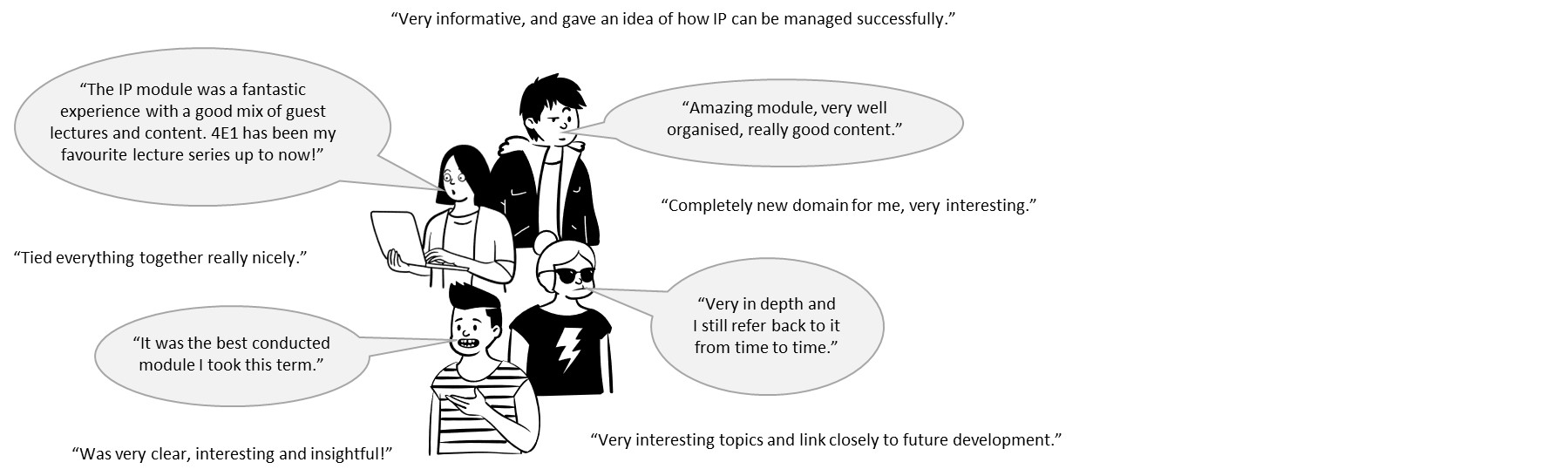
Student feedback:


Topics typically covered in this module include:


Innovation and the need for strategic IP management

  • Introduction to IP rights systems
  • Digital economy, multi-technology products and IP complexity
  • Global challenges and the need for innovation
  • The rise of open cumulative innovation, open source and the need for novel approaches to IP
  • Incentives to innovate, motives to patent, and the patenting paradox


IP systems, prosecution, litigation

  • Formal and informal IP rights (appropriability regimes)
  • Patenting features and patent quality
  • Patent procedures and renewals
  • Ownership and reassignments
  • Counterfeiting, infringement and litigation


IP analytics to support decision making

  • Patent features that are available for analysing patent data         
  • Introduction to IP analytics including free and commercial software tools
  • Patent databases, search strategies and indicators for analysing patent data (patent landscaping and mining)
  • Approaches for patent landscaping, technology foresight/ intelligence, understanding competitors and identifying emerging/ disruptive technologies
  • AI, machine and deep learning approaches for IP analytics


Technology, strategic and economic value as fundamental concepts for effective IP management 

  • The concept of value and value dimensions (strategic, economic, technological, social)
  • The value of data in the AI age
  • Established and emerging valuation approaches for IP


Markets for technology and IP licensing

  • Supply and demand sides of markets for technologies, innovations and data in the context of open innovation
  • Technology market intermediaries, e.g. non-practicing entities
  • IP ecosystems
  • Licensing models, contracts, methods to determine royalty rates, negotiations 
  • IP based business models
  • IP licensing for creating sustainable impact
  • Standard essential patents and FRAND principles


Managing IP in collaborative innovation processes 

  • Managing IP in open, collaborative and distributed innovation processes
  • Contracts and ownership considerations in collaborative R&D projects


IP risk management

  • Types of IP associated risks, e.g. reputational, operational and strategic
  • IP risk assessment process
  • Mitigation strategies to minimize IP associated risks


Developing effective IP strategies

  • How IP strategies help maximizing value creation and capture
  • IP strategy typologies
  • IP strategies for accelerating technology diffusion (e.g. patent pledges)
  • IP acquisition and exploitation/ commercialization strategies for inbound and outbound open innovation
  • Tools and toolkits for developing IP strategies


Organisational and operational aspects of IP management

  • Challenges for organizations’ IP cultures when firms move towards more effective, value driven IP management
  • Organizational principles and processes for effective IP management (e.g. incentive systems, invention disclosure)
  • IP challenges in mergers and acquisitions (e.g. due diligence, disassembly problems)


Further notes

Additional readings and resources for this module will be made available on the module’s Moodle page. Assessment details will be given at the start of the module.


Coursework

Coursework assignment 100%.

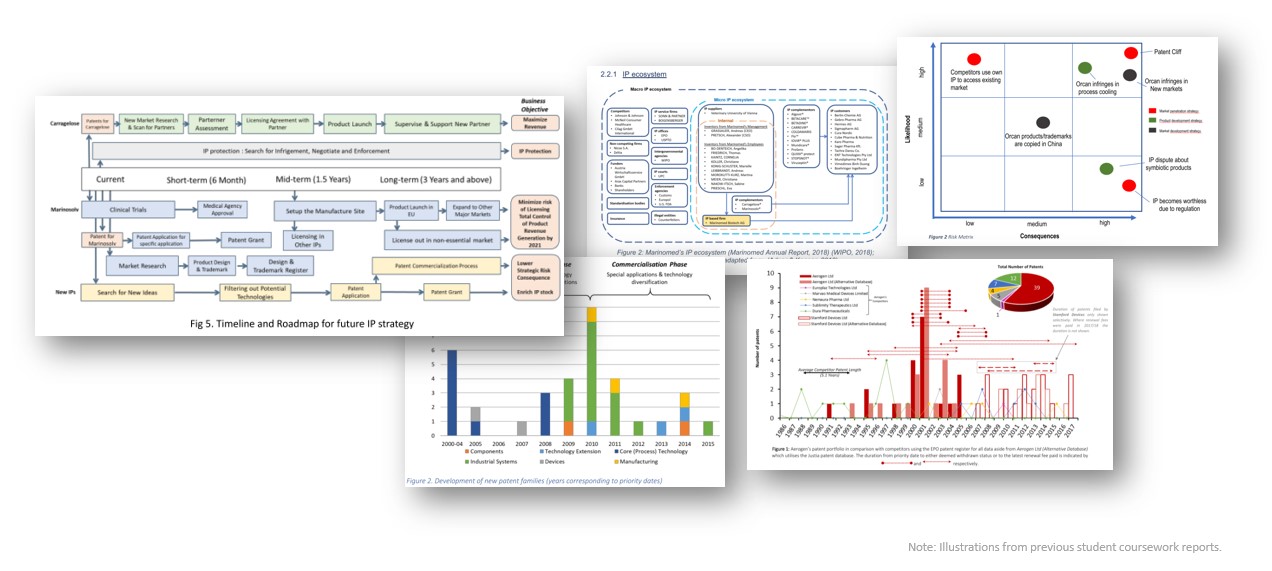
Student will have to apply the knowledge gained in this module by developing an IP strategy for a selected case company. An IP analysis of the company’s own portfolio, those of relevant current and future competitors is an important element of the coursework. Students are expected to use relevant frameworks and tools that are introduced during the module for the coursework assignment. 

Coursework Format

Due date

& marks

To develop an IP strategy for a selected case company, which includes an identification of relevant ecosystem actors, an analysis of the company’s and competitors’ IP portfolios, and the development of an IP strategy for the case company drawing upon the knowledge and tools/ approaches gained during the module. 

Further details will be available on the module's Moodle page. 

Individual report, anonymously marked

Towards the end of the module (specific date and details will be provided at the beginning of the module)


Booklists

The module mostly relies on academic articles, which will be shared with students via the module's Moodle page. 

Examples of books with relevance for this module are: 


  • Chesbrough, H. W. (2006). Open Innovation: The New Imperative for Creating and Profiting from Technology, Harvard Business Press. 

  • Contreras, J. (2022). Intellectual Property Licensing and Transactions: Theory and Practice. Cambridge: Cambridge University Press. 

  • Granstrand, O. (1999). The Economics and Management of Intellectual Property: Towards Intellectual Capitalism. Cheltenham, UK and Northampton, MA, USA, Edward Elgar Publishing. 

  • Phelps, M. and D. Kline (2009). Burning the Ships: Intellectual Property and the Transformation of Microsoft, Wiley Hoboken. 

  • O’Connell, D. (2011). Harvesting External Innovation, Gower Publishing. 

  • O’Connell, D. (2021). Intellectual Property Risk Management. Independently published. 

  • Rognstad, O. and Ørstavik I. (2021) Intellectual Property and Sustainable Markets. Cheltenham, UK: Edward Elgar Publishing.  

  • Teece, D. J. (2000). Managing Intellectual Capital: Organizational, Strategic, and Policy Dimensions, OUP Oxford. 


Examination Guidelines

Please refer to Form & conduct of the examinations.

 
Last modified: 04/06/2025 13:28

Engineering Tripos Part IIB, 4E1: Innovation & Strategic Management of Intellectual Property, 2024-25

Leader

Professor Frank Tietze

Lecturer

Professor Frank Tietze

Guest speakers

Speakers from different industries (e.g. senior IP managers) and governmental organisations (e.g. European Patent Office) will complement the academic lectures.

Timing and Structure

Michaelmas term (Monday 14:00 - 16:00). Teaching for this module should take place in-person (unless governmental guidance will prevent this) with a guest speaker potentially joining online (details to be announced on the Moodle page).

Prerequisites

There are no prerequisites for attending this module. However, students will receive pre-reading material covering IP essentials which students are expected to have studied before the third lecture. This pre-reading will equip students with a basic understanding of the different IP rights, such as patents, trademarks, design rights, copyrights, and trade secrets.

Aims

The aims of the course are to:

  • Acknowledge the relevance of IP for technology-based companies, particularly in collaborative innovation processes and innovation systems.
  • Understand how to manage IP to achieve and maintain competitive advantage.
  • Understand how to share IP through different licensing mechanisms, such as for creating sustainable impact.
  • Understand techniques/ methods/ approaches for developing IP strategies that support long term business success and create sustainable impact.
  • Possess the relevant know how to access and use IP data and analytics to support business related decision making.

Objectives

As specific objectives, by the end of the course students should be able to:

  • Appreciate the interdisciplinary nature of IP for technology and innovation management.
  • Understand and apply relevant concepts, frameworks, tools, and theories introduced during the module.
  • Be aware about business situations in which IP might be important to consider.
  • Be enabled to interact with professionals (managers, R&D engineers, lawyers) in IP related business conversations.
  • Understand the opportunities that companies can create by strategically managing IP.

Content

Intellectual assets and intellectual (IP) play a pivotal role for today’s technology champions and tomorrow’s innovators. This module adopts an engineering management perspective on the role and use of IP by innovative companies.

The module builds on the state of the art in strategic IP management thinking for maximizing value appropriation from predominantly technological innovations and collaborative innovation processes. The module focuses on the management of formal IP rights (e.g. patents, trademarks, design rights, copyrights), but also covers the increasingly relevant informal IP (e.g. data/algorithms, know-how, trade secrets). The module particularly emphasises the way how companies use IP to contribute to the sustainable development goals (SDGs) and create sustainable impact, such as by developing green/ clean technologies (e.g. renewable energy, plastic alternatives, meat substitutes) or social impact (e.g. for job creation in low- and middle-income countries).


By definition, IP is an interdisciplinary subject. IP created by inventors, often engineers or scientists, needs to be managed and valued for decision making by executives and IP lawyers, who act within the scope of the associated legal systems. In the module we adopt an engineering management perspective on IP. Occasionally, however, we also touch on related concepts from law and economics.

During the module we run interactive, in-class exercises, talk about case examples and discuss more in-depth case studies. For instance, we look at the Dolby case study, which is a fascinating example of how a company has evolved its IP strategy over three decades along with changing technological, market and business environments to become one of the world’s most successful licensing businesses.

The module examines different approaches to IP strategies across industries. For instance, pharmaceutical companies typically rely on relatively small and focused patent portfolios, while firms in the electronics and ICT sectors typically have larger and more divers IP portfolios. For students to gain an understanding of different IP strategies in different industries, we bring in guest speakers with extensive practical experience (e.g. head of IP, vice presidents, senior IP managers) covering different industries.

Guest speakers from governmental organisations, such as the European Patent Office (EPO) and the World Intellectual Property Organisation (WIPO) join the module to help students understand the role of and functioning of IP rights systems.


-----------------------------------------------------------------------------------------------------------

Student feedback:


Topics typically covered in this module include:


Innovation and the need for strategic IP management

  • Introduction to IP rights systems
  • Digital economy, multi-technology products and IP complexity
  • Global challenges and the need for innovation
  • The rise of open cumulative innovation, open source and the need for novel approaches to IP
  • Incentives to innovate, motives to patent, and the patenting paradox


IP systems, prosecution, litigation

  • Formal and informal IP rights (appropriability regimes)
  • Patenting features and patent quality
  • Patent procedures and renewals
  • Ownership and reassignments
  • Counterfeiting, infringement and litigation


IP analytics to support decision making

  • Patent features that are available for analysing patent data         
  • Introduction to IP analytics including free and commercial software tools
  • Patent databases, search strategies and indicators for analysing patent data (patent landscaping and mining)
  • Approaches for patent landscaping, technology foresight/ intelligence, understanding competitors and identifying emerging/ disruptive technologies
  • AI, machine and deep learning approaches for IP analytics


Technology, strategic and economic value as fundamental concepts for effective IP management 

  • The concept of value and value dimensions (strategic, economic, technological, social)
  • The value of data in the AI age
  • Established and emerging valuation approaches for IP


Markets for technology and IP licensing

  • Supply and demand sides of markets for technologies, innovations and data in the context of open innovation
  • Technology market intermediaries, e.g. non-practicing entities
  • IP ecosystems
  • Licensing models, contracts, methods to determine royalty rates, negotiations 
  • IP based business models
  • IP licensing for creating sustainable impact
  • Standard essential patents and FRAND principles


Managing IP in collaborative innovation processes 

  • Managing IP in open, collaborative and distributed innovation processes
  • Contracts and ownership considerations in collaborative R&D projects


IP risk management

  • Types of IP associated risks, e.g. reputational, operational and strategic
  • IP risk assessment process
  • Mitigation strategies to minimize IP associated risks


Developing effective IP strategies

  • How IP strategies help maximizing value creation and capture
  • IP strategy typologies
  • IP strategies for accelerating technology diffusion (e.g. patent pledges)
  • IP acquisition and exploitation/ commercialization strategies for inbound and outbound open innovation
  • Tools and toolkits for developing IP strategies


Organisational and operational aspects of IP management

  • Challenges for organizations’ IP cultures when firms move towards more effective, value driven IP management
  • Organizational principles and processes for effective IP management (e.g. incentive systems, invention disclosure)
  • IP challenges in mergers and acquisitions (e.g. due diligence, disassembly problems)


Further notes

Additional readings and resources for this module will be made available on the module’s Moodle page. Assessment details will be given at the start of the module.


Coursework

Coursework assignment 100%.

Student will have to apply the knowledge gained in this module by developing an IP strategy for a selected case company. An IP analysis of the company’s own portfolio, those of relevant current and future competitors is an important element of the coursework. Students are expected to use relevant frameworks and tools that are introduced during the module for the coursework assignment. 

Coursework Format

Due date

& marks

To develop an IP strategy for a selected case company, which includes an identification of relevant ecosystem actors, an analysis of the company’s and competitors’ IP portfolios, and the development of an IP strategy for the case company drawing upon the knowledge and tools/ approaches gained during the module. 

Further details will be available on the module's Moodle page. 

Individual report, anonymously marked

Towards the end of the module (specific date and details will be provided at the beginning of the module)


Booklists

The module mostly relies on academic articles, which will be shared with students via the module's Moodle page. 

Examples of books with relevance for this module are: 


  • Chesbrough, H. W. (2006). Open Innovation: The New Imperative for Creating and Profiting from Technology, Harvard Business Press. 

  • Contreras, J. (2022). Intellectual Property Licensing and Transactions: Theory and Practice. Cambridge: Cambridge University Press. 

  • Granstrand, O. (1999). The Economics and Management of Intellectual Property: Towards Intellectual Capitalism. Cheltenham, UK and Northampton, MA, USA, Edward Elgar Publishing. 

  • Phelps, M. and D. Kline (2009). Burning the Ships: Intellectual Property and the Transformation of Microsoft, Wiley Hoboken. 

  • O’Connell, D. (2011). Harvesting External Innovation, Gower Publishing. 

  • O’Connell, D. (2021). Intellectual Property Risk Management. Independently published. 

  • Rognstad, O. and Ørstavik I. (2021) Intellectual Property and Sustainable Markets. Cheltenham, UK: Edward Elgar Publishing.  

  • Teece, D. J. (2000). Managing Intellectual Capital: Organizational, Strategic, and Policy Dimensions, OUP Oxford. 


Examination Guidelines

Please refer to Form & conduct of the examinations.

 
Last modified: 31/05/2024 10:06

Engineering Tripos Part IIB, 4E1: Innovation & Strategic Management of Intellectual Property, 2023-24

Leader

Professor Frank Tietze

Lecturer

Professor Frank Tietze

Guest speakers

Speakers from different industries (e.g. senior IP managers) and governmental organisations (e.g. European Patent Office) will complement the academic lectures.

Timing and Structure

Michaelmas term (Monday 14:00 - 16:00). Teaching for this module should take place in-person (unless governmental guidance will prevent this) with a guest speaker potentially joining online (details to be announced on the Moodle page).

Prerequisites

There are no prerequisites for attending this module. However, students will receive pre-reading material covering IP essentials which students are expected to have studied before the third lecture. This pre-reading will equip students with a basic understanding of the different IP rights, such as patents, trademarks, design rights, copyrights, and trade secrets.

Aims

The aims of the course are to:

  • Acknowledge the relevance of IP for technology-based companies, particularly in collaborative innovation processes and innovation systems.
  • Understand how to manage IP to achieve and maintain competitive advantage.
  • Understand how to share IP through different licensing mechanisms, such as for creating sustainable impact.
  • Understand techniques/ methods/ approaches for developing IP strategies that support long term business success and create sustainable impact.
  • Possess the relevant know how to access and use IP data and analytics to support business related decision making.

Objectives

As specific objectives, by the end of the course students should be able to:

  • Appreciate the interdisciplinary nature of IP for technology and innovation management.
  • Understand and apply relevant concepts, frameworks, tools, and theories introduced during the module.
  • Be aware about business situations in which IP might be important to consider.
  • Be enabled to interact with professionals (managers, R&D engineers, lawyers) in IP related business conversations.
  • Understand the opportunities that companies can create by strategically managing IP.

Content

Intellectual assets and intellectual (IP) play a pivotal role for today’s technology champions and tomorrow’s innovators. This module adopts an engineering management perspective on the role and use of IP by innovative companies.

The module builds on the state of the art in strategic IP management thinking for maximizing value appropriation from predominantly technological innovations and collaborative innovation processes. The module focuses on the management of formal IP rights (e.g. patents, trademarks, design rights, copyrights), but also covers the increasingly relevant informal IP (e.g. data/algorithms, know-how, trade secrets). The module particularly emphasises the way how companies use IP to contribute to the sustainable development goals (SDGs) and create sustainable impact, such as by developing green/ clean technologies (e.g. renewable energy, plastic alternatives, meat substitutes) or social impact (e.g. for job creation in low- and middle-income countries).


By definition, IP is an interdisciplinary subject. IP created by inventors, often engineers or scientists, needs to be managed and valued for decision making by executives and IP lawyers, who act within the scope of the associated legal systems. In the module we adopt an engineering management perspective on IP. Occasionally, however, we also touch on related concepts from law and economics.

During the module we run interactive, in-class exercises, talk about case examples and discuss more in-depth case studies. For instance, we look at the Dolby case study, which is a fascinating example of how a company has evolved its IP strategy over three decades along with changing technological, market and business environments to become one of the world’s most successful licensing businesses.

The module examines different approaches to IP strategies across industries. For instance, pharmaceutical companies typically rely on relatively small and focused patent portfolios, while firms in the electronics and ICT sectors typically have larger and more divers IP portfolios. For students to gain an understanding of different IP strategies in different industries, we bring in guest speakers with extensive practical experience (e.g. head of IP, vice presidents, senior IP managers) covering different industries.

Guest speakers from governmental organisations, such as the European Patent Office (EPO) and the World Intellectual Property Organisation (WIPO) join the module to help students understand the role of and functioning of IP rights systems.


-----------------------------------------------------------------------------------------------------------

Student feedback:


Topics typically covered in this module include:


Innovation and the need for strategic IP management

  • Introduction to IP rights systems
  • Digital economy, multi-technology products and IP complexity
  • Global challenges and the need for innovation
  • The rise of open cumulative innovation, open source and the need for novel approaches to IP
  • Incentives to innovate, motives to patent, and the patenting paradox


IP systems, prosecution, litigation

  • Formal and informal IP rights (appropriability regimes)
  • Patenting features and patent quality
  • Patent procedures and renewals
  • Ownership and reassignments
  • Counterfeiting, infringement and litigation


IP analytics to support decision making

  • Patent features that are available for analysing patent data         
  • Introduction to IP analytics including free and commercial software tools
  • Patent databases, search strategies and indicators for analysing patent data (patent landscaping and mining)
  • Approaches for patent landscaping, technology foresight/ intelligence, understanding competitors and identifying emerging/ disruptive technologies
  • AI, machine and deep learning approaches for IP analytics


Technology, strategic and economic value as fundamental concepts for effective IP management 

  • The concept of value and value dimensions (strategic, economic, technological, social)
  • The value of data in the AI age
  • Established and emerging valuation approaches for IP


Markets for technology and IP licensing

  • Supply and demand sides of markets for technologies, innovations and data in the context of open innovation
  • Technology market intermediaries, e.g. non-practicing entities
  • IP ecosystems
  • Licensing models, contracts, methods to determine royalty rates, negotiations 
  • IP based business models
  • IP licensing for creating sustainable impact
  • Standard essential patents and FRAND principles


Managing IP in collaborative innovation processes 

  • Managing IP in open, collaborative and distributed innovation processes
  • Contracts and ownership considerations in collaborative R&D projects


IP risk management

  • Types of IP associated risks, e.g. reputational, operational and strategic
  • IP risk assessment process
  • Mitigation strategies to minimize IP associated risks


Developing effective IP strategies

  • How IP strategies help maximizing value creation and capture
  • IP strategy typologies
  • IP strategies for accelerating technology diffusion (e.g. patent pledges)
  • IP acquisition and exploitation/ commercialization strategies for inbound and outbound open innovation
  • Tools and toolkits for developing IP strategies


Organisational and operational aspects of IP management

  • Challenges for organizations’ IP cultures when firms move towards more effective, value driven IP management
  • Organizational principles and processes for effective IP management (e.g. incentive systems, invention disclosure)
  • IP challenges in mergers and acquisitions (e.g. due diligence, disassembly problems)


Further notes

Additional readings and resources for this module will be made available on the module’s Moodle page. Assessment details will be given at the start of the module.


Coursework

Coursework assignment 100%.

Student will have to apply the knowledge gained in this module by developing an IP strategy for a selected case company. An IP analysis of the company’s own portfolio, those of relevant current and future competitors is an important element of the coursework. Students are expected to use relevant frameworks and tools that are introduced during the module for the coursework assignment. 

Coursework Format

Due date

& marks

To develop an IP strategy for a selected case company, which includes an identification of relevant ecosystem actors, an analysis of the company’s and competitors’ IP portfolios, and the development of an IP strategy for the case company drawing upon the knowledge and tools/ approaches gained during the module. 

Further details will be available on the module's Moodle page. 

Individual report, anonymously marked

Towards the end of the module (specific date and details will be provided at the beginning of the module)


Booklists

The module mostly relies on academic articles, which will be shared with students via the module's Moodle page. 

Examples of books with relevance for this module are: 


  • Chesbrough, H. W. (2006). Open Innovation: The New Imperative for Creating and Profiting from Technology, Harvard Business Press. 

  • Contreras, J. (2022). Intellectual Property Licensing and Transactions: Theory and Practice. Cambridge: Cambridge University Press. 

  • Granstrand, O. (1999). The Economics and Management of Intellectual Property: Towards Intellectual Capitalism. Cheltenham, UK and Northampton, MA, USA, Edward Elgar Publishing. 

  • Phelps, M. and D. Kline (2009). Burning the Ships: Intellectual Property and the Transformation of Microsoft, Wiley Hoboken. 

  • O’Connell, D. (2011). Harvesting External Innovation, Gower Publishing. 

  • O’Connell, D. (2021). Intellectual Property Risk Management. Independently published. 

  • Rognstad, O. and Ørstavik I. (2021) Intellectual Property and Sustainable Markets. Cheltenham, UK: Edward Elgar Publishing.  

  • Teece, D. J. (2000). Managing Intellectual Capital: Organizational, Strategic, and Policy Dimensions, OUP Oxford. 


Examination Guidelines

Please refer to Form & conduct of the examinations.

 
Last modified: 10/07/2023 15:03

Engineering Tripos Part IIB, 4E1: Innovation & Strategic Management of Intellectual Property, 2022-23

Leader

Professor Frank Tietze

Lecturer

Professor Frank Tietze

Guest lecturer

Dr Pratheeba Vimalnath

Guest speakers

Speakers from different industries (e.g. senior IP managers) and governmental organisations (e.g. European Patent Office) will complement the academic lectures.

Timing and Structure

Michaelmas term (Monday 14:00 - 16:00). Teaching for this module should take place in-person (unless governmental guidance will prevent this) with a guest speaker potentially joining online (details to be announced on the Moodle page).

Prerequisites

There are no prerequisites for attending this module. However, students will receive pre-reading material covering IP essentials which students are expected to have studied before the third lecture. This pre-reading will equip students with a basic understanding of the different IP rights, such as patents, trademarks, design rights, copyrights, and trade secrets.

Aims

The aims of the course are to:

  • Acknowledge the relevance of IP for technology-based companies, particularly in collaborative innovation processes and innovation systems.
  • Understand how to manage IP to achieve and maintain competitive advantage.
  • Understand how to share IP through different licensing mechanisms, such as for creating sustainable impact.
  • Understand techniques/ methods/ approaches for developing IP strategies that support long term business success and create sustainable impact.
  • Possess the relevant know how to access and use IP data and analytics to support business related decision making.

Objectives

As specific objectives, by the end of the course students should be able to:

  • Appreciate the interdisciplinary nature of IP for technology and innovation management.
  • Understand and apply relevant concepts, frameworks, tools, and theories introduced during the module.
  • Be aware about business situations in which IP might be important to consider.
  • Be enabled to interact with professionals (managers, R&D engineers, lawyers) in IP related business conversations.
  • Understand the opportunities that companies can create by strategically managing IP.

Content

Intellectual assets and intellectual (IP) play a pivotal role for today’s technology champions and tomorrow’s innovators. This module adopts an engineering management perspective on the role and use of IP by innovative companies.

The module builds on the state of the art in strategic IP management thinking for maximizing value appropriation from predominantly technological innovations and collaborative innovation processes. The module focuses on the management of formal IP rights (e.g. patents, trademarks, design rights, copyrights), but also covers the increasingly relevant informal IP (e.g. data/algorithms, know-how, trade secrets). The module particularly emphasises the way how companies use IP to contribute to the sustainable development goals (SDGs) and create sustainable impact, such as by developing green/ clean technologies (e.g. renewable energy, plastic alternatives, meat substitutes) or social impact (e.g. for job creation in low- and middle-income countries).


By definition, IP is an interdisciplinary subject. IP created by inventors, often engineers or scientists, needs to be managed and valued for decision making by executives and IP lawyers, who act within the scope of the associated legal systems. In the module we adopt an engineering management perspective on IP. Occasionally, however, we also touch on related concepts from law and economics.

During the module we run interactive, in-class exercises, talk about case examples and discuss more in-depth case studies. For instance, we look at the Dolby case study, which is a fascinating example of how a company has evolved its IP strategy over three decades along with changing technological, market and business environments to become one of the world’s most successful licensing businesses.

The module examines different approaches to IP strategies across industries. For instance, pharmaceutical companies typically rely on relatively small and focused patent portfolios, while firms in the electronics and ICT sectors typically have larger and more divers IP portfolios. For students to gain an understanding of different IP strategies in different industries, we bring in guest speakers with extensive practical experience (e.g. head of IP, vice presidents, senior IP managers) covering different industries.

Guest speakers from governmental organisations, such as the European Patent Office (EPO) and the World Intellectual Property Organisation (WIPO) join the module to help students understand the role of and functioning of IP rights systems.


-----------------------------------------------------------------------------------------------------------

Student feedback:


Topics typically covered in this module include:


Innovation and the need for strategic IP management

  • Introduction to IP rights systems
  • Digital economy, multi-technology products and IP complexity
  • Global challenges and the need for innovation
  • The rise of open cumulative innovation, open source and the need for novel approaches to IP
  • Incentives to innovate, motives to patent, and the patenting paradox


IP systems, prosecution, litigation

  • Formal and informal IP rights (appropriability regimes)
  • Patenting features and patent quality
  • Patent procedures and renewals
  • Ownership and reassignments
  • Counterfeiting, infringement and litigation


IP analytics to support decision making

  • Patent features that are available for analysing patent data         
  • Introduction to IP analytics including free and commercial software tools
  • Patent databases, search strategies and indicators for analysing patent data (patent landscaping and mining)
  • Approaches for patent landscaping, technology foresight/ intelligence, understanding competitors and identifying emerging/ disruptive technologies
  • AI, machine and deep learning approaches for IP analytics


Technology, strategic and economic value as fundamental concepts for effective IP management 

  • The concept of value and value dimensions (strategic, economic, technological, social)
  • The value of data in the AI age
  • Established and emerging valuation approaches for IP


Markets for technology and IP licensing

  • Supply and demand sides of markets for technologies, innovations and data in the context of open innovation
  • Technology market intermediaries, e.g. non-practicing entities
  • IP ecosystems
  • Licensing models, contracts, methods to determine royalty rates, negotiations 
  • IP based business models
  • IP licensing for creating sustainable impact
  • Standard essential patents and FRAND principles


Managing IP in collaborative innovation processes 

  • Managing IP in open, collaborative and distributed innovation processes
  • Contracts and ownership considerations in collaborative R&D projects


IP risk management

  • Types of IP associated risks, e.g. reputational, operational and strategic
  • IP risk assessment process
  • Mitigation strategies to minimize IP associated risks


Developing effective IP strategies

  • How IP strategies help maximizing value creation and capture
  • IP strategy typologies
  • IP strategies for accelerating technology diffusion (e.g. patent pledges)
  • IP acquisition and exploitation/ commercialization strategies for inbound and outbound open innovation
  • Tools and toolkits for developing IP strategies


Organisational and operational aspects of IP management

  • Challenges for organizations’ IP cultures when firms move towards more effective, value driven IP management
  • Organizational principles and processes for effective IP management (e.g. incentive systems, invention disclosure)
  • IP challenges in mergers and acquisitions (e.g. due diligence, disassembly problems)


Further notes

Additional readings and resources for this module will be made available on the module’s Moodle page. Assessment details will be given at the start of the module.


Coursework

Coursework assignment 100%.

Student will have to apply the knowledge gained in this module by developing an IP strategy for a selected case company. An IP analysis of the company’s own portfolio, those of relevant current and future competitors is an important element of the coursework. Students are expected to use relevant frameworks and tools that are introduced during the module for the coursework assignment. 

Coursework Format

Due date

& marks

To develop an IP strategy for a selected case company, which includes an identification of relevant ecosystem actors, an analysis of the company’s and competitors’ IP portfolios, and the development of an IP strategy for the case company drawing upon the knowledge and tools/ approaches gained during the module. 

Further details will be available on the module's Moodle page. 

Individual report, anonymously marked

Towards the end of the module (specific date and details will be provided at the beginning of the module)


Booklists

The module mostly relies on academic articles, which will be shared with students via the module's Moodle page. 

Examples of books with relevance for this module are: 


  • Chesbrough, H. W. (2006). Open Innovation: The New Imperative for Creating and Profiting from Technology, Harvard Business Press. 

  • Contreras, J. (2022). Intellectual Property Licensing and Transactions: Theory and Practice. Cambridge: Cambridge University Press. 

  • Granstrand, O. (1999). The Economics and Management of Intellectual Property: Towards Intellectual Capitalism. Cheltenham, UK and Northampton, MA, USA, Edward Elgar Publishing. 

  • Phelps, M. and D. Kline (2009). Burning the Ships: Intellectual Property and the Transformation of Microsoft, Wiley Hoboken. 

  • O’Connell, D. (2011). Harvesting External Innovation, Gower Publishing. 

  • O’Connell, D. (2021). Intellectual Property Risk Management. Independently published. 

  • Rognstad, O. and Ørstavik I. (2021) Intellectual Property and Sustainable Markets. Cheltenham, UK: Edward Elgar Publishing.  

  • Teece, D. J. (2000). Managing Intellectual Capital: Organizational, Strategic, and Policy Dimensions, OUP Oxford. 


Examination Guidelines

Please refer to Form & conduct of the examinations.

 
Last modified: 06/07/2022 13:59

Engineering Tripos Part IIB, 4E1: Innovation & Strategic Management of Intellectual Property, 2021-22

Leader

Dr Frank Tietze

Lecturer

Dr Frank Tietze

Guest lecturer

Dr Pratheeba Vimalnath

Guest speakers

Speakers from different industries (e.g. senior IP managers) and governmental organisations (e.g. European Patent Office) will complement the academic lectures

Timing and Structure

Michaelmas term (Monday 14:00 - 16:00). All teaching for this module will take place according to governmental guidance, preferably in-person, but potentially hybrid or online (for details see Moodle page). Assessment: 100% coursework

Prerequisites

Students attending this module are provided pre-reading material covering what the different IP rights are, the key concepts and limitations which students are expected to study before the second lecture of this module. Students are expected to have a basic understanding of the different IP rights, such as patents, trademarks, design rights, copyright and trade secrets.

Aims

The aims of the course are to:

  • acknowledge the relevance of intellectual property (IP) in today’s technology and innovation systems and colloborative innovation processes.
  • understand how to strategically manage IP to achieve and maintain competitive advantage.
  • understand ways and tools for developing IP strategies that support long term business success.
  • know how to use IP data and analytics to support business related decision making.

Objectives

As specific objectives, by the end of the course students should be able to:

  • appreciate the interdisciplinary nature of IP management.
  • understand and apply relevant concepts, frameworks, tools and theories introduced during the module.
  • be enabled to interact with professionals (managers, R&D engineers, lawyers) in IP related business conversations.
  • understand the opportunities strategic IP management can create to develop and maintain competitive advantage.

Content

Lectures will be delivered in person, but streamed via ZOOM at the same time (also recorded and made available via Panopto).

The module builds on the state of the art in strategic IP management thinking for maximizing value appropriation from predominatenly technological innovations. By definition, IP is an interdisciplinary concept. In the module we emphasise an engineering management perspective on IP, the module also touches on related concepts from law and economics. During the module we  will run exercises, discuss examples, and a more indepth case study. The Dolby story is a facinating case of how IP strategies evolve along the development of one of the most successful licensing businesses, particularly with Dolby's strong link to Cambridge as a Pembroke alumni. Emphasis will be, where possible on IP strategies for sustainable / green technologies and innovations. 

IP strategies differ across industries. While pharmaceutical companies typically rely on relatively small patent portfolios, firms in the electronics and ICT sectors typically have larger and more divers IP portfolios and employ different IP strategies. For students to gain an understanding of the different IP approaches in different sectors, we bring in guest speakers with strong practical experience in different sectors. In addition, guest speakers from governmental organisations, such as the European Patent Office (EPO) and the World Intellectual Property Organisation (WIPO) enhance students' learning experience by providing insights into the functioning of IP systems.

1Innovation and the need for strategic IP management (Guest speaker from European Patent Office - EPO tbc)

This session will introduce the module structure, the assessment exercise and set the scene by explaining why strategic IP management has become increasingly relevant for many industries over the last decades. 

·         Introduction to the patent system

·         Digital economy, multi-technology products and the IP complexity challenge

·         The rise of open / cumulative innovation and open source and the need for collaborative and open innovation

·         Incentives to innovate, motives to patent, and the patenting paradox

·         Intellectual assets, intellectual capital and intellectual property


2. IP systems, prosection and litigation & searching and analysing patent data 

While it is expected that students have read the pre-course reading material, this session revisits some of the IP basics and covers some of the legal and IP system issues, e.g. by introducing relevant legal frameworks.

·         Formal and informal IP rights (appropriability regimes)

·         Patenting procedures and renewals

·         Ownership and reassignments

·         Counterfeits, patent quality, infringement and litigation

·         Patent databases, search strategies and indicators for analysing patent data (patent landscaping and mining)

·         Technology foresight, intelligence, understanding competitors and identifying weak signals (emerging and disruptive technologies) 

·         AI, machine and deep learning approaches for IP analytics


3. Technology, strategic and economic value as fundamental concept for effective IP management (Guest speaker from World Intellectual Property Organisation - WIPO tbc)

This session introduces students to the concept of value with its various dimensions, established as well as emerging approaches for valuing intangible assets. Being able to put a "price tag" on an intellectual assets is as fundamental to firms' making decison than knowing what tangible assets are worth, but just a tiny little bit more challenging. 

·         The concept of value and value dimensions (strategic, economic, technological)

·         The value of data in the AI age

·         Established and emerging valuation approaches for intangible assets


4. Mastering markets for technology and licensing

This session introduces tothe relevant concepts around technology markets, particularly in the context of open innovation, the different actors on the supply and demand side (in the innovation ecosystem) as well as intermediaries and relevant managerial issues regarding licensing.

·         Supply and demand sides of markets for technologies, innovations and data

·         Technology market intermediaries, NPEs and patent trolls

·         The micro and macro IP ecosystem

·         Licensing models, contracts, royalty rates, negotiations 

·         IP based business models

·         Standard essential patents and FRAND


5.  Managing IP in collaborative innovation processes & IP risk management (Guest speaker: Pharmaceutical industry tbc)

The session introduces considerations in collaborative innovation and IP associated risks.

·         Mangaing IP in open, collaborative and distributed innovation processes

·        Contracts and ownership considerations 

·        Reputational, operational and strategic IP associated risks

·        IP risk assessment and mitigation strategies

·        IP management in R&D collaborations (open innovation paradox)


6. Developing effective IP strategies (Guest speaker: Medical device industry tbc)

This session focuses on different IP strategies as well as tools and toolkits that can be deployed to developed IP strategies. 

·         IP strategies for maximizing value creation and capture

·         IP strategy typologies

·         Strategies for accelerating technology diffusion (patent pledges)

·         IP acquisition and exploitation / commercialization strategies for inbound and outbound innovation

·         Tools and toolkits for developing IP strategies


7. Dolby case study & the future of IP management (Guest speaker: Global engineering tbc)

In this session students will discuss the Dolby case study and hear some concepts and ideas that will change the way how IP will be used to gain and maintain competitive advantage. Students will hear from a guest speaker how a global engineering company develop and deployed a sophisticated IP management system across multinational divisions. 

·         Challenges for organizations IP cultures when firms move towards more effective, value driven IP management

·         Organizational principles and processes (incentive systems, invention disclosure) for effective IP management

·         IP challenges in mergers and acquisitions (due diligence, disassembly problem)

·         Effectively managing actors in the IP ecosystem       


8. Strategic IP management and innovation – the full picture (Guest speaker: Electronics / ICT / IoT industry tbc)

This session will bring together the content, frameworks, concepts and tools of all lecture in a guest lecture and wrap-up session.

Further notes

Additional readings and resources for this module will be available on the respective Moodle page. Details will be given at the start of the module.

Coursework

Coursework assignment 100%.

Student will have to apply their knowledge gained in this module by developing an IP strategy for a selected case company. An IP analysis of the company’s own portfolio, those of relevant current and future competitors is a key element of the assignment. During the module the students will be introduced to relevant frameworks and tools, which they will be expected to use for the coursework. The coursework will comprise an individual report. 

Coursework Format

Due date

& marks

To develop an IP strategy for a selected case company, which includes an analysis of the company’s IP portfolio and relevant actors in the IP ecosystem, drawing upon the knowledge from the different sessions in the module. 
 
Further details will be available on the module's Moodle page. 

Individual report, anonymously marked

Towards the end of the module (specific date and details will be provided at the beginning of the module)


Booklists

Recommended books for this module:

  • Chesbrough, H. W. (2006). Open Innovation: The New Imperative for Creating and Profiting from Technology, Harvard Business Press.
  • Granstrand, O. (1999). The Economics and Management of Intellectual Property: Towards Intellectual Capitalism. Cheltenham, UK and Northampton, MA, USA, Edward Elgar Publishing.
  • Phelps, M. and D. Kline (2009). Burning the Ships: Intellectual Property and the Transformation of Microsoft, Wiley Hoboken.
  • O’Connell, D. (2011). Harvesting External Innovation, Gower Publishing.
  • Teece, D. J. (2000). Managing Intellectual Capital: Organizational, Strategic, and Policy Dimensions, OUP Oxford.


Examination Guidelines

Please refer to Form & conduct of the examinations.

 
Last modified: 07/10/2021 10:58

Engineering Tripos Part IIB, 4E1: Innovation & Strategic Management of Intellectual Property, 2020-21

Leader

Dr Frank Tietze

Lecturer

Dr Frank Tietze

Guest lecturer

Dr Pratheeba Vimalnath

Guest lecturer

Leonidas Aristodemou

Guest speakers

Speakers from different industries and governmental organisation will complement the academic lectures

Timing and Structure

Michaelmas term (Monday 15:00 - 17:00). All teaching for this module will take place live online (for details see Moodle page). Assessment: 100% coursework

Prerequisites

Students attending this module are provided pre-reading material covering what the different IP rights are, the key concepts and limitations which students are expected to study before the second lecture of this module. Students are expected to have a basic understanding of the different IP rights, such as patents, trademarks, design rights, copyright and trade secrets.

Aims

The aims of the course are to:

  • acknowledge the relevance of intellectual property (IP) in today’s technology and innovation systems and colloborative innovation processes.
  • understand how to strategically manage IP to achieve and maintain competitive advantage.
  • be able to develop IP strategies that support long term business success.
  • know how to use IP data and analytics to support business related decision making.

Objectives

As specific objectives, by the end of the course students should be able to:

  • appreciate the interdisciplinary nature of IP management.
  • understand and apply relevant concepts, frameworks, tools and theories introduced during the module.
  • be enabled to interact with professionals (managers, R&D engineers, lawyers) in IP related business conversations.
  • understand the opportunities strategic IP management can create to develop and maintain competitive advantage.

Content


The module builds on the state of the art in strategic IP management thinking for maximizing value appropriation from predominatenly technological innovations. By definition, IP is an interdisciplinary concept. In the module we emphasise an engineering management perspective on IP, the module also touches on related concepts from law and economics. During the module we  will run exercises, discuss examples, and a more indepth case study. The Dolby story is a facinating case of how IP strategies evolve along the development of one of the most successful licensing businesses, particularly with Dolby's strong link to Cambridge as a Pembroke alumni.

IP strategies differ across industries. While pharmaceutical companies typically rely on relatively small patent portfolios, firms in the electornics and ICT sectors typically have larger and more divers IP portfolios and employ different IP strategies. For students to gain an understanding of the different IP approaches in different sectors, we bring in guest speakers with strong experience in different sectors. In addition, guest speakers from governmental organisations, such as the European Patent Office (EPO) and the World Intellectual Property Organisation (WIPO) enhance students' learning experience by providing insights into the functioning of IP systems.

1Innovation and the need for strategic IP management (Guest speaker: European Patent Office - EPO)

This session will introduce the module structure, the assessment exercise and set the scene by explaining why strategic IP management has become increasingly relevant for many industries over the last decades. 

·         Introduction to the patent system

·         Digital economy, multi-technology products and the IP complexity challenge

·         The rise of open / cumulative innovation and open source and the need for collaborative and open innovation

·         Incentives to innovate, motives to patent, and the patenting paradox

·         Intellectual assets, intellectual capital and intellectual property


2. IP systems, prosection and litigation & searching and analysing patent data 

While it is expected that students have read the pre-course reading material, this session revisits some of the IP basics and covers some of the legal and IP system issues, e.g. by introducing relevant legal frameworks.

·         Formal and informal IP rights (appropriability regimes)

·         Patenting procedures and renewals

·         Ownership and reassignments

·         Counterfeits, patent quality, infringement and litigation

·         Patent databases, search strategies and indicators for analysing patent data (patent landscaping and mining)

·         Technology foresight, intelligence, understanding competitors and identifying weak signals (emerging and disruptive technologies) 

·         AI, machine and deep learning approaches for IP analytics


3. Technology, strategic and economic value as fundamental concept for effective IP management (Guest speaker: World Intellectual Property Organisation - WIPO)

This session introduces students to the concept of value with its various dimensions, established as well as emerging approaches for valuing intangible assets. Being able to put a "price tag" on an intellectual assets is as fundamental to firms' making decison than knowing what tangible assets are worth, but just a tiny little bit more challenging. 

·         The concept of value and value dimensions (strategic, economic, technological)

·         The value of data in the AI age

·         Established and emerging valuation approaches for intangible assets


4. Mastering markets for technology and licensing

This session introduces tothe relevant concepts around technology markets, particularly in the context of open innovation, the different actors on the supply and demand side (in the innovation ecosystem) as well as intermediaries and relevant managerial issues regarding licensing.

·         Supply and demand sides of markets for technologies, innovations and data

·         Technology market intermediaries, NPEs and patent trolls

·         The micro and macro IP ecosystem

·         Licensing models, contracts, royalty rates, negotiations 

·         IP based business models

·         Standard essential patents and FRAND


5.  Managing IP in collaborative innovation processes & IP risk management (Guest speaker: Pharmaceutical industry)

The session introduces considerations in collaborative innovation and IP associated risks.

·         Mangaing IP in open, collaborative and distributed innovation processes

·        Contracts and ownership considerations 

·        Reputational, operational and strategic IP associated risks

·        IP risk assessment and mitigation strategies

·        IP management in R&D collaborations (open innovation paradox)


6. Developing effective IP strategies (Guest speaker: Medical device industry)

This session focuses on different IP strategies as well as tools and toolkits that can be deployed to developed IP strategies. 

·         IP strategies for maximizing value creation and capture

·         IP strategy typologies

·         Strategies for accelerating technology diffusion (patent pledges)

·         IP acquisition and exploitation / commercialization strategies for inbound and outbound innovation

·         Tools and toolkits for developing IP strategies


7. Dolby case study & the future of IP management (Guest speaker: Global engineering)

In this session students will discuss the Dolby case study and hear some concepts and ideas that will change the way how IP will be used to gain and maintain competitive advantage. Students will hear from a guest speaker how a global engineering company develop and deployed a sophisticated IP management system across multinational divisions. 

·         Challenges for organizations IP cultures when firms move towards more effective, value driven IP management

·         Organizational principles and processes (incentive systems, invention disclosure) for effective IP management

·         IP challenges in mergers and acquisitions (due diligence, disassembly problem)

·         Effectively managing actors in the IP ecosystem       


8. Strategic IP management and innovation – the full picture (Guest speaker: Electronics / ICT / IoT industry)

This session will bring together the content, frameworks, concepts and tools of all lecture in a guest lecture and wrap-up session.

Further notes

Additional readings and resources for this module will be available on the respective Moodle page. Details will be given at the start of the module.

Coursework

Coursework assignment 100%.

Student will have to apply their knowledge gained in this module by developing an IP strategy for a selected case company. An IP analysis of the company’s own portfolio, those of relevant current and future competitors is a key element of the assignment. During the module the students will be introduced to relevant frameworks and tools, which they will be expected to use for the coursework. The coursework will comprise an individual report. 

Coursework Format

Due date

& marks

To develop an IP strategy for a selected case company, which includes an analysis of the company’s IP portfolio and relevant actors in the IP ecosystem, drawing upon the knowledge from the different sessions in the module. 
 
Further details will be available on the module's Moodle page. 

Individual report, anonymously marked

Towards the end of the module (specific date and details will be provided at the beginning of the module)


Booklists

Recommended books for this module:

-          Granstrand, O. (1999). The Economics and Management of Intellectual Property: Towards Intellectual Capitalism. Cheltenham, UK and Northampton, MA, USA, Edward Elgar Publishing.

-          Phelps, M. and D. Kline (2009). Burning the Ships: Intellectual Property and the Transformation of Microsoft, Wiley Hoboken.

-          O’Connell, D. (2011). Harvesting External Innovation, Gower Publishing.

-          Chesbrough, H. W. (2006). Open Innovation: The New Imperative for Creating and Profiting from Technology, Harvard Business Press.

-          Teece, D. J. (2000). Managing Intellectual Capital: Organizational, Strategic, and Policy Dimensions, OUP Oxford.


Examination Guidelines

Please refer to Form & conduct of the examinations.

 
Last modified: 07/10/2020 12:54

Engineering Tripos Part IIB, 4F14: Computer Systems, 2025-26

Module Leader

Prof Andrew Gee

Lecturers

Prof Andrew Gee and Prof Per Ola Kristensson

Timing and Structure

Lent Term. 12 lectures and 2 examples classes. 75% exam / 25% coursework.

Prerequisites

Part 1 Digital Circuits and Computing, including an understanding of C++ as taught in the Mars Lander project and the Part 1B Device Programming exercise. Students will be expected to write small programs in C++.

Aims

The aims of the course are to:

  • Describe the computer hardware that underlies modern information processing systems.
  • Explain how to write multithreaded software that runs on such hardware.

Objectives

As specific objectives, by the end of the course students should be able to:

  • Appreciate the basic components needed to construct a computer and the different ways to interconnect these components, including the various ways of exploiting parallelism.
  • Compare the instruction sets, implementation issues and performance of CISC and RISC architectures.
  • Design efficient hardware for computer arithmetic.
  • Understand the operation of pipelined datapaths.
  • Describe memory organisation, addressing schemes and the use of caches; and their effects on performance.
  • Compare the various ways of handling input and output in a computer system.
  • Understand the concept of a memory model.
  • Understand basic concurrency concepts.
  • Design and implement thread-safe algorithms in C++.

Content

Parallel Programming (4 lectures, Prof Per Ola Kristensson)

  • C++ memory model.
  • Race conditions, mutual exclusion, synchronization, starvation.
  • Thread-safe data structures.
  • C++ threading library.

Assessment: coursework (25%)

Computer Systems (8 lectures and 2 examples classes, Prof Andrew Gee)

  • Computer architecture, historical perspectives.
  • Instruction set architectures, RISC vs CISC.
  • ALU design, datapaths and control, pipelining.
  • Memory hierarchy, caches, virtual memory.
  • Input/output, bus organization, polling and interrupt-driven I/O, DMA.
  • Parallel processing, SIMD and MIMD architectures.

Assessment: examination (75%), candidates to attempt two questions from a choice of three

Coursework

Multithreaded programming using the C++ memory model and threading libraries. The programming exercise is an opportunity to experience how theoretical concepts from the lectures translate into actual working code using a state-of-the-art industry standard threading library. Time required: 4-8 hours programming plus 15 minutes demonstrating and discussing your code with an assessor. Please note that coursework assessment is not anonymous.

Coursework Format

Due date

& marks

Multithreaded programming

Learning objectives:

  • To gain practical experience with the C++ threading library.
  • To design and implement thread-safe data structures.
  • To practice concurrency control so as to avoid race conditions and starvation.

Individual

Demonstrating your software

Not anonymously marked

Software to be written during Lent Term

Assessment at end of Lent Term [15/60]


Booklists

Please refer to the Booklist for Part IIB Courses for references to this module, this can be found on the associated Moodle course.

Examination Guidelines

Please refer to Form & conduct of the examinations.

 
Last modified: 11/08/2025 09:14

Engineering Tripos Part IIB, 4F14: Computer Systems, 2024-25

Module Leader

Prof Andrew Gee

Lecturers

Prof Andrew Gee and Prof Per Ola Kristensson

Timing and Structure

Lent Term. 12 lectures and 2 examples classes. 75% exam / 25% coursework. Lectures will be recorded.

Prerequisites

Part 1 Digital Circuits and Computing, including an understanding of C++ as taught in the Mars Lander project and the Part 1B Device Programming exercise. Students will be expected to write small programs in C++.

Aims

The aims of the course are to:

  • Describe the computer hardware that underlies modern information processing systems.
  • Explain how to write multithreaded software that runs on such hardware.

Objectives

As specific objectives, by the end of the course students should be able to:

  • Appreciate the basic components needed to construct a computer and the different ways to interconnect these components, including the various ways of exploiting parallelism.
  • Compare the instruction sets, implementation issues and performance of CISC and RISC architectures.
  • Design efficient hardware for computer arithmetic.
  • Understand the operation of pipelined datapaths.
  • Describe memory organisation, addressing schemes and the use of caches; and their effects on performance.
  • Compare the various ways of handling input and output in a computer system.
  • Understand the concept of a memory model.
  • Understand basic concurrency concepts.
  • Design and implement thread-safe algorithms in C++.

Content

Computer Systems (8 lectures and 2 examples classes, Prof Andrew Gee)

  • Computer architecture, historical perspectives.
  • Instruction set architectures, RISC vs CISC.
  • ALU design, datapaths and control, pipelining.
  • Memory hierarchy, caches, virtual memory.
  • Input/output, bus organization, polling and interrupt-driven I/O, DMA.
  • Parallel processing, SIMD and MIMD architectures.

Assessment: examination (75%), candidates to attempt two questions from a choice of three

Parallel Programming (4 lectures, Prof Per Ola Kristensson)

  • C++ memory model.
  • Race conditions, mutual exclusion, synchronization, starvation.
  • Thread-safe data structures.
  • C++ threading library.

Assessment: coursework (25%)

Coursework

Multithreaded programming using the C++ memory model and threading libraries. The programming exercise is an opportunity to experience how theoretical concepts from the lectures translate into actual working code using a state-of-the-art industry standard threading library. Time required: 4-8 hours programming plus 15 minutes demonstrating and discussing your code with an assessor. Please note that coursework assessment is not anonymous.

Coursework Format

Due date

& marks

Multithreaded programming

Learning objectives:

  • To gain practical experience with the C++ threading library.
  • To design and implement thread-safe data structures.
  • To practice concurrency control so as to avoid race conditions and starvation.

Individual

Demonstrating your software

Not anonymously marked

Software to be written during Lent Term

Assessment at end of Lent Term [15/60]


Booklists

Please refer to the Booklist for Part IIB Courses for references to this module, this can be found on the associated Moodle course.

Examination Guidelines

Please refer to Form & conduct of the examinations.

 
Last modified: 31/05/2024 10:08

Pages

Subscribe to CUED undergraduate teaching site RSS