

Undergraduate Teaching 2025-26

Not logged in. More information may be available... Login via Raven / direct.

Engineering Tripos Part IIB, 4B25: Embedded Systems for the Internet of Things, 2019-20

Module Leader

Dr P Stanley-Marbell

Lecturer

Dr P Stanley-Marbell

Timing and Structure

Michaelmas term. 100% coursework

Prerequisites

3B2 useful. Starting in 2019/2020, this module has been further enhanced with material relevant for students interested in applying ideas from Bayesian inference to sensor data analysis.

Aims

The aims of the course are to:

  • Introduce students to the principles and practice of computation and sensing systems that interact with the physical world.
  • Provide students an introduction to a Bayesian view of measurements, measurement uncertainty, sensors, and computing on sensor data that is synergistic with other research and teaching in the Department of Engineering at the University of Cambridge.

Objectives

As specific objectives, by the end of the course students should be able to:

  • Define the role of uncertainty in measurements of physical signals and quantify measurement uncertainty for a given sensing system.
  • Evaluate energy use in an embedded system using in-system current monitors.
  • Define the role of noise in both measurements and displays and identify appropriate metrics to use in quantifying noise for a given design.
  • Derive analytic relations underlying a Bayesian view of measurements, measurement uncertainty, sensors, and computing on sensor data.
  • Design communication subsystems and the required electrical circuit support between a collection of I2C- or SPI-interfaced sensor integrated circuits and an ARM Cortex-M0 microcontroller.
  • Numerically quantify measurement uncertainty and noise in outputs given a system design.
  • Recall and explain the interaction between displays and the human visual system.
  • Design modifications to sensing, communication, and display systems to improve their energy efficiency.
  • Design the logical organization and required firmware for new systems built around an ARM Cortex-M0 microcontroller, and sensors or displays connected via I2C and SPI communication interfaces.

Content

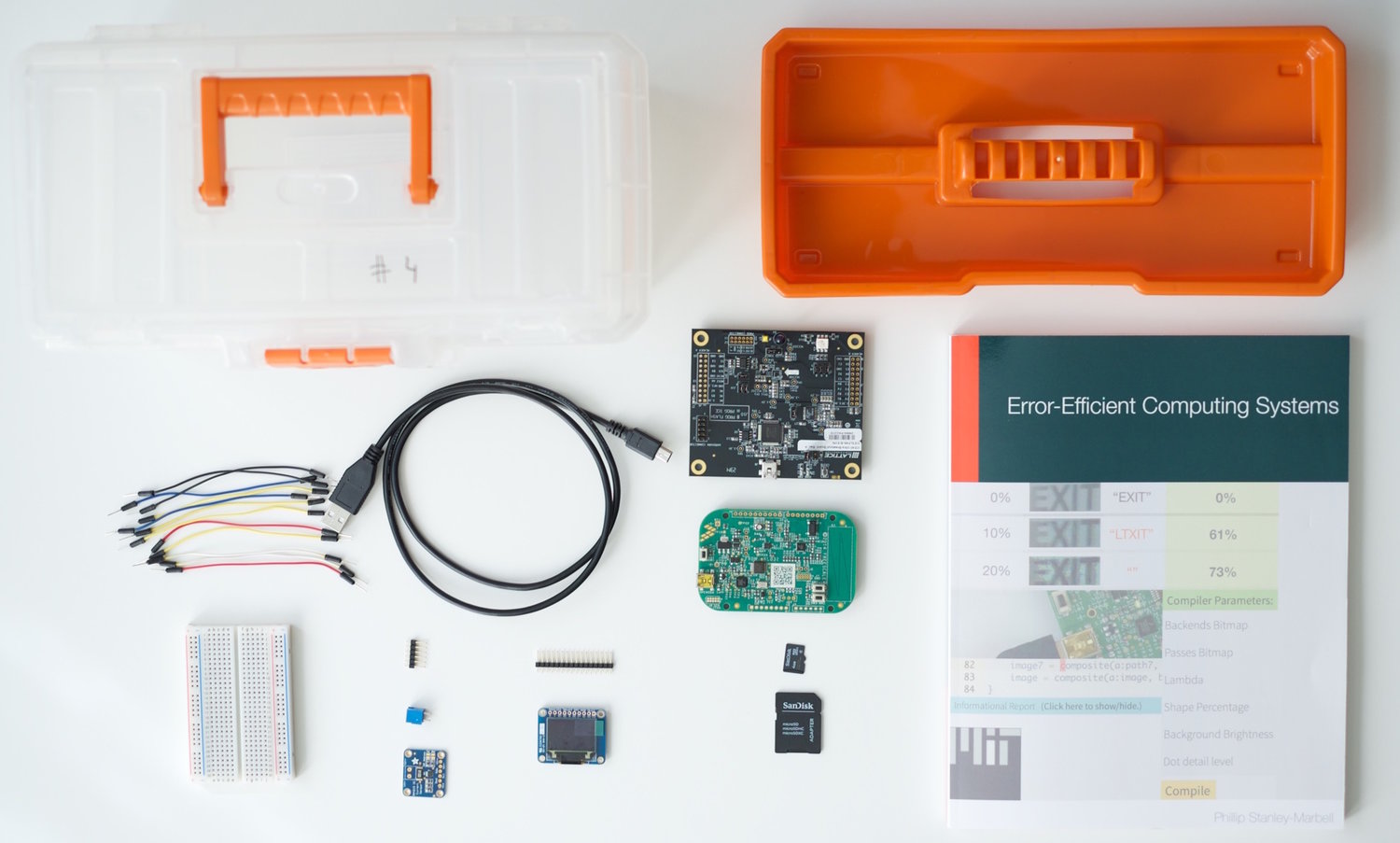
The module will introduce students to the principles underlying sensor operation, signal acquisition, the role of measurement uncertainty and noise, common sensor communication interfaces and how they interact with modern embedded microcontrollers such as the ARM Cortex-M0 family. The module will link these concepts in the signal acquisition and processing chain to a study of output interfaces in embedded systems. This exploration of output systems will be built on a study of the principles of operation of OLED displays and how the flexibility of the human visual system enables interesting circuit- and algorithm-level techniques to reduce display power dissipation.

Preliminary Syllabus

Lecture 1: System overview of sensing, computation, I/O, and displays in embedded systems; interpreting device and system datasheets. At the end of this lecture, students should be able to: enumerate the important components in an embedded system design; read and interpret the datasheet for a component in a system or for an entire system; propose and design changes to a system to extend its uses.

Lecture 2: Precision, accuracy, reliability, and measurement uncertainty.  Noise sources in analog and digital systems; role of signal gain and restoring logic. At the end of this lecture, students should be able to: define precision, accuracy, reliability, and measurement uncertainty; analyze a system design and quantify these properties for a design's components; enumerate the sources of noise and measurement uncertainty in analog and digital systems; propose design changes to improve the robustness of systems to noise.

Lecture 3: C and assembly programming for embedded systems. At the end of this lecture, students should be able to: implement firmware that runs in the abscence of an operating system and which contains a mixture of C and ARM assembly code.

Lecture 4: Sensors, embedded I/O interfaces, and noise: Commercial sensor integrated circuits; I2C, SPI (and I2S, I3C, MIPI DSI, and MIPI CSI); noise in integrated circuits (Johnson-Nyquist noise, shot noise, 1/f noise, random telegraph noise).  At the end of this lecture, students should be able to: enumerate the differences between the common embedded wired communication interfaces; select and substantiate a choice for an interface for a given design problem; enumerate the different potential sources of noise in integrated systems.

Lecture 5: A Bayesian view of measurements, measurement uncertainty, sensors, and computing on sensor data.

Lecture 6: Field-programmable gate arrays in low-power embedded systems; Verilog overview.  At the end of this lecture, students should be able to: describe and explain the basic architecture of FPGAs; use their understanding of the Verilog hardware description language and FPGA synthesis tools to modify an existing Verilog design.

Lecture 7: Human color vision perception and its interaction with OLED displays: Their structure, interfaces, and techniques for energy-efficiency.  At the end of this lecture, students should be able to: enumerate the properties of OLED displays; propose changes to existing system designs that use OLED displays in order to improve their energy efficiency; enumerate the basic properties of human color vision that have a bearing on the design of displays for embedded systems.

Lecture 8: Physical invariants in embedded systems.  At the end of this lecture, students should be able to: define physical invariants in the context of a sensor-driven system; apply concepts from Lagrangians, Hamiltonians, the Euler-Lagrange Equations, Noether's theorem, and recent research on inferring Lagrangians and Hamiltonians from sensor data to embedded systems designs.

Lecture 9: Wireless communications using Bluetooth, 802.15.4/Zigbee, and LoRa; Bluetooth HCI interface.  At the end of this lecture, students should be able to: enumerate the differences between the major low-power radio interfaces available for embedded or Internet-of-Things systems; propose energy-efficient choices for a wireless sensing system design given the application's design constraints.

Lecture 10: Case study: Designing new embedded systems to solve a specified application need.  At the end of this lecture, students should be able to: propose an architectural design comprising sensing, computation, communication, and display to address a given application need, with the design implementable within the limitations of schematic capture and printed-circuit-board layout tools such as Eagle.

Lecture 11: Evaluating the efficacy of embedded computing systems: Power, performance, and noise measurements.  At the end of this lecture, students should be able to: quantify the time-performance, energy-efficiency, power-efficiency, and uncertainty in embedded computing systems. Adapt the design of embedded sensing and computation systems that are Pareto-optimal with respect to alternatives.


Further notes

Pictures of individual final project from previous years

The pictures below are for a sample of the individual student projects, for students who gave consent for pictures of their final demo system to be used in future instances of 4B25.


2018: Lightness illusion test (using ARM Cortex-M0+ microcontroller and 96x64 color OLED display from the course kit):


2018: Apollo guidance computer (custom PCB):


2018: Physical security to prevent card skimming (using 3-axis MEMS accelerometer and ARM Cortex-M0+):


2018: Elder care door alarm (using 3-axis MEMS accelerometer, ARM Cortex-M0+, and 96x64 color OLED display from the course kit in custom laser-cut enclosure):


2018: Air quality analysis system (using Bosch BME680 environmental sensor, ARM Cortex-M0+ microcontroller from the course kit, and a custom-designed PCB):


2017: Pedometer (using 3-axis MEMS accelerometer, ARM Cortex-M0+, and 96x64 color OLED display from the course kit in custom laser-cut enclosure):

2017: Bike theft alarm (using 3-axis MEMS accelerometer and ARM Cortex-M0+ from the course kit, in custom 3D-printed enclosure):


2017: Pedometer (using 3-axis MEMS accelerometer, ARM Cortex-M0+, and color 96x64 OLED display from the course kit):


2017: Plant health monitor using external conductivity, light, temperature, and humidity sensors together with the ARM Cortex-M0+ and color 96x64 OLED display from the course kit:


2017: Sensor fusion (GPS + velocity) using FRDM KL25Z and GPS module together with 3-axis MEMS accelerometer and 96x64 OLED display from the course kit:


2017: Razor cut prediction (HDC1000 humidity sensor and force-sensing resistor together with 3-axis MEMS accelerometer and ARM Cortex-M0+ from the course kit):


2017: RFID-based class attendance monitor (using INA219 current measurement board, ARM Cortex-M0+, and color 96x64 OLED display from the course kit):


2017: Custom multi-layer PCB for sports injury detection, using the same KL03 Cortex-M0+ as in the course kit:


2017: Electric bike controller (using INA219 current monitor, ARM Cortex-M0+, and color 96x64 OLED display from the course kit):


2017: Pedometer (using a counter module attached to the ARM Cortex-M0+ and 3-axis MEMS accelerometer from the course kit):


2017: Rotating pyramid demo and OLED display driver implemented in only 2k RAM on the microcontroller, using the ARM Cortex-M0+ and color 96x64 OLED display from the course kit:

Coursework

Coursework Format

Due date

& marks

Coursework activity #1: Embedded processor emulator exercise

Use the GCC and Binutils tools to compile, link, and disassemble binaries and use an open-source embedded system emulator to run a few different programs written in a combination of C and assembly language.

Learning objective:

After successfully completing this exercise, students should be able to:


  • Write simple programs using combination of C and assembler
  • Compile and run programs directly on an embedded processor with no OS
  • Create, use, and modify Makefiles and Linker Command Files
  • Use Linker Map Files and differentiate them from Linker Command Files

Individual.

Source files, binaries, and text file with answers to questions.

non-anonymously marked


Friday, 25th October (week 3)

[20%]

Coursework activity #2: OLED display control over SPI exercise

Obtain hands-on experience writing a device driver in C for an SPI peripheral, using the FRDMKL03 ARM board and the OLED display from the course hardware kit.

Learning objective:

After successfully completing this exercise, students should be able to:


  • Read a datasheet for an unfamiliar embedded hardware component such as an SPI peripheral and write a device driver in C to interface with the peripheral.

Individual.

Source files, binaries, picture of working system, wiring diagram, and text file with answers to questions.

non-anonymously marked

  Friday, 8th November (week 5)

[20%]


Coursework activity #3: Project proposal one-page report

Identify an interesting engineering problem that can be addressed using an embedded system developed using the concepts, theory, techniques, and tools covered in this course.

Learning objectives:

After successfully completing this exercise, students should be able to:


  • Identify an interesting and important engineering challenge that can be solved using a combination of embedded sensing, embedded computation, and possibly displays and communication.
  • Present a clear list of design objectives for solving the engineering challenge using an embedded system.

Individual Report.

Non-anonymously marked.

  Friday, 15th November (week 6)

[5%]


Coursework activity #4: Power measurement using TI INA219 I2C device exercise

Obtain hands-on experience writing a device driver in C for an I2C peripheral, using the FRDMKL05 ARM board and the TI INA219 daughterboard from the course hardware kit.

Learning objective:

After successfully completing this exercise, students should be able to:

  • Read a datasheet for an unfamiliar embedded hardware component such as an I2C peripheral and write a device driver in C to interface with the peripheral.

Individual.

Source files, binaries, picture of working system, wiring diagram, and text file with answers to questions.

Non-anonymously marked.

  Friday, 22nd November (week 7)

[20%]


Coursework activity #5: Project concept, design, implementation, and final report

Present the problem addressed, approach employed, system implemented, and system evaluation.

Learning objectives:

After successfully completing the final project, students should be able to:

  • Identify an interesting and important engineering challenge that can be solved using a combination of embedded sensing, embedded computation, and possibly displays and communication.
  • Design an embedded computing system that address the engineering challenge.
  • Prototype an embedded system design using a combination of sensors, microcontrollers, communication, displays, or FPGAs using the tools provided in the course kit, and potentially design a custom PCB implementing the design.
  • Quantitatively evaluate an embedded sensing and computation system in terms of its time efficiency (performance), energy efficiency (battery life), and measurement and data processing accuracy.

Individual report, source files, binaries, in-person demonstration at final feedback session.

Non-anonymously marked.

  Friday, 17th January (Lent Term)

[35%]


Booklists

The following books are relevant to the material in the course and will all be available from the Engineering Library.

  1. Introduction to Embedded Systems, A Cyber-Physical Systems Approach, ISBN: 978-0262533812
  2. An Introduction to Uncertainty in Measurement, ISBN: 978-0521605793
  3. Linkers and Loaders, ISBN: 978-1558604964
  4. The Circuit Designer's Companion, 3rd Edition, ISBN: 978-0080971384
  5. The Practice of Programming, ISBN: 978-0201615869
  6. Expert C Programming, ISBN: 978-0131774292
  7. C: A Reference Manual (5th Edition), ISBN: 978-0130895929
  8. Bluetooth Low Energy: The Developer's Handbook, ISBN: 978-0132888363
  9. Programming Embedded Systems: With C and GNU Development Tools, 2nd Edition, ISBN: 978-0596009830
  10. Embedded Systems Dictionary, ISBN: 978-1578201204
  11. The Art of Designing Embedded Systems, Second Edition, ISBN: 978-0750686440
  12. The Art of Electronics, ISBN: 978-0521809269
  13. Color Science: Concepts and Methods, Quantitative Data and Formulae, ISBN: 978-0471399186

Examination Guidelines

Please refer to Form & conduct of the examinations.

 
Last modified: 10/10/2019 16:01
Engineering Tripos Part IIB, 4B25: Embedded Systems for the Internet of Things, 2018-19

Module Leader

Dr P Stanley-Marbell

Lecturer

Dr P Stanley-Marbell

Timing and Structure

Michaelmas term. 100% coursework

Prerequisites

3B2 useful

Aims

The aims of the course are to:

  • Introduce students to the principles and practice of computation and sensing systems that interact with the physical world.

Objectives

As specific objectives, by the end of the course students should be able to:

  • Define the role of uncertainty in measurements of physical signals and quantify measurement uncertainty for a given sensing system.
  • Evaluate energy use in an embedded system using in-system current monitors.
  • Define the role of noise in both measurements and displays and identify appropriate metrics to use in quantifying noise for a given design.
  • Design communication subsystems and the required electrical circuit support between a collection of I2C- or SPI-interfaced sensor integrated circuits and an ARM Cortex-M0 microcontroller.
  • Numerically quantify measurement uncertainty and noise in outputs given a system design.
  • Recall and explain the interaction between displays and the human visual system.
  • Design modifications to sensing, communication, and display systems to improve their energy efficiency.
  • Design the logical organization and required firmware for new systems built around an ARM Cortex-M0 microcontroller, and sensors or displays connected via I2C and SPI communication interfaces.

Content

The module will introduce students to the principles underlying sensor operation, signal acquisition, the role of measurement uncertainty and noise, common sensor communication interfaces and how they interact with modern embedded microcontrollers such as the ARM Cortex-M0 family. The module will link these concepts in the signal acquisition and processing chain to a study of output interfaces in embedded systems. This exploration of output systems will be built on a study of the principles of operation of OLED displays and how the flexibility of the human visual system enables interesting circuit- and algorithm-level techniques to reduce display power dissipation.

Preliminary Syllabus

Lecture 1: System overview of sensing, computation, I/O, and displays in embedded systems; interpreting device and system datasheets. At the end of this lecture, students should be able to: enumerate the important components in an embedded system design; read and interpret the datasheet for a component in a system or for an entire system; propose and design changes to a system to extend its uses.

Lecture 2: Precision, accuracy, reliability, and measurement uncertainty.  Noise sources in analog and digital systems; role of signal gain and restoring logic. At the end of this lecture, students should be able to: define precision, accuracy, reliability, and measurement uncertainty; analyze a system design and quantify these properties for a design's components; enumerate the sources of noise and measurement uncertainty in analog and digital systems; propose design changes to improve the robustness of systems to noise.

Lecture 3: C and assembly programming for embedded systems. At the end of this lecture, students should be able to: implement firmware that runs in the abscence of an operating system and which contains a mixture of C and ARM assembly code.

Lecture 4: Sensors, embedded I/O interfaces, and noise: Commercial sensor integrated circuits; I2C, SPI (and I2S, I3C, MIPI DSI, and MIPI CSI); noise in integrated circuits (Johnson-Nyquist noise, shot noise, 1/f noise, random telegraph noise).  At the end of this lecture, students should be able to: enumerate the differences between the common embedded wired communication interfaces; select and substantiate a choice for an interface for a given design problem; enumerate the different potential sources of noise in integrated systems.

Lecture 5: Case study.

Lecture 6: Field-programmable gate arrays in low-power embedded systems; Verilog overview.  At the end of this lecture, students should be able to: describe and explain the basic architecture of FPGAs; use their understanding of the Verilog hardware description language and FPGA synthesis tools to modify an existing Verilog design.

Lecture 7: Human color vision perception and its interaction withOLED displays: Their structure, interfaces, and techniques for energy-efficiency.  At the end of this lecture, students should be able to: enumerate the properties of OLED displays; propose changes to existing system designs that use OLED displays in order to improve their energy efficiency; enumerate the basic properties of human color vision that have a bearing on the design of displays for embedded systems.

Lecture 8: Physical invariants in embedded systems.  At the end of this lecture, students should be able to: define physical invariants in the context of a sensor-driven system; apply concepts from Lagrangians, Hamiltonians, the Euler-Lagrange Equations, Noether's theorem, and recent research on inferring Lagrangians and Hamiltonians from sensor data to embedded systems designs.

Lecture 9: Wireless communications using Bluetooth, 802.15.4/Zigbee, and LoRa; Bluetooth HCI interface.  At the end of this lecture, students should be able to: enumerate the differences between the major low-power radio interfaces available for embedded or Internet-of-Things systems; propose energy-efficient choices for a wireless sensing system design given the application's design constraints.

Lecture 10: Schematic capture and basic printed circuit board layout using Eagle.  At the end of this lecture, students should be able to: create a design ready to be submitted for manufacturing (Gerber files) using the Eagle schematic capture and printed-circuit-board layout tools.

Lecture 11: Designing new embedded systems to solve a specified application need.  At the end of this lecture, students should be able to: propose an architectural design comprising sensing, computation, communication, and display to address a given application need, with the design implementable within the limitations of schematic capture and printed-circuit-board layout tools such as Eagle.

Further notes

Pictures of individual final project from previous years

The pictures below are for a sample of the individual student projects, for students who gave consent for pictures of their final demo system to be used in future instances of 4B25.


Pedometer (using 3-axis MEMS accelerometer, ARM Cortex-M0+, and 96x64 color OLED display from the course kit in custom laser-cut enclosure):


Bike theft alarm (using 3-axis MEMS accelerometer and ARM Cortex-M0+ from the course kit, in custom 3D-printed enclosure):


Pedometer (using 3-axis MEMS accelerometer, ARM Cortex-M0+, and color 96x64 OLED display from the course kit):


Plant health monitor using external conductivity, light, temperature, and humidity sensors together with the ARM Cortex-M0+ and color 96x64 OLED display from the course kit:


Sensor fusion (GPS + velocity) using FRDM KL25Z and GPS module together with 3-axis MEMS accelerometer and 96x64 OLED display from the course kit:


Razor cut prediction (HDC1000 humidity sensor and force-sensing resistor together with 3-axis MEMS accelerometer and ARM Cortex-M0+ from the course kit):


RFID-based class attendance monitor (using INA219 current measurement board, ARM Cortex-M0+, and color 96x64 OLED display from the course kit):


Custom multi-layer PCB for sports injury detection, using the same KL03 Cortex-M0+ as in the course kit:


Electric bike controller (using INA219 current monitor, ARM Cortex-M0+, and color 96x64 OLED display from the course kit):


Pedometer (using a counter module attached to the ARM Cortex-M0+ and 3-axis MEMS accelerometer from the course kit):


OpenGL subset (rotating pyramid demo) and OLED display driver implemented in only 2k RAM on the microcontroller, using the ARM Cortex-M0+ and color 96x64 OLED display from the course kit:

Coursework

Coursework Format

Due date

& marks

Coursework activity #1: Embedded processor emulator exercise

Use the GCC and Binutils tools to compile, link, and disassemble binaries and use an open-source embedded system emulator to run a few different programs written in a combination of C and assembly language.

Learning objective:

After successfully completing this exercise, students should be able to:


  • Write simple programs using combination of C and assembler
  • Compile and run programs directly on an embedded processor with no OS
  • Create, use, and modify Makefiles and Linker Command Files
  • Use Linker Map Files and differentiate them from linker command files

Individual

Source files, binaries, and text file with answers to questions.

non-anonymously marked


Friday, 19th October (week 3)

[10%]

Coursework activity #1: OLED display control over SPI exercise

Obtain hands-on experience writing a device driver in C for an SPI peripheral, using the FRDMKL03 ARM board and the OLED display from the course hardware kit.

Learning objective:

After successfully completing this exercise, students should be able to:


  • Read a datasheet for an unfamiliar embedded hardware component such as an SPI peripheral and write a device driver in C to interface with the peripheral.

Source files, binaries, picture of working system, wiring diagram, and text file with answers to questions.

non-anonymously marked

  Friday, 26th October (week 4)

[15%]


Coursework activity #3: Project proposal one-page report

Identify an interesting engineering problem that can be addressed using an embedded system developed using the concepts, theory, techniques, and tools covered in this course.

Learning objectives:

After successfully completing this exercise, students should be able to:


  • Identify an interesting and important engineering challenge that can be solved using a combination of embedded sensing, embedded computation, and possibly displays and communication.
  • Present a clear list of design objectives for solving the engineering challenge using an embedded system.

Individual Report

non-anonymously marked

  Friday, 2nd November (week 5)

[5%]


Coursework activity #4: Power measurement using TI INA219 I2C device exercise

Obtain hands-on experience writing a device driver in C for an I2C peripheral, using the FRDMKL05 ARM board and the TI INA219 daughterboard from the course hardware kit.

Learning objective:

After successfully completing this exercise, students should be able to:

  • Read a datasheet for an unfamiliar embedded hardware component such as an I2C peripheral and write a device driver in C to interface with the peripheral.

Source files, binaries, picture of working system, wiring diagram, and text file with answers to questions.

non-anonymously marked

  Friday, 9th November (week 6)

[15%]


Coursework activity #5: Project interim report

Present progress made towards final project goals, evaluate lessons learned so far, and obtain feedback and guidance on necessary plan adaptation.

Learning objectives:

After successfully completing the interim project report, students should be able to:

  • Identify and present progress made towards final project.
  • Identify and present potential challenges and propose necessary changes to project plan.

Individual Report

non-anonymously marked

  Friday, 23rd November (week 8)

[10%]


Coursework activity #6: Project concept, design, implementation, and final report

Present the problem addressed, approach employed, system implemented, and system evaluation.

Learning objectives:

After successfully completing the final project, students should be able to:

  • Identify an interesting and important engineering challenge that can be solved using a combination of embedded sensing, embedded computation, and possibly displays and communication.
  • Design an embedded computing system that address the engineering challenge.
  • Prototype an embedded system design using a combination of sensors, microcontrollers, communication, displays, or FPGAs using the tools provided in the course kit, and potentially design a custom PCB implementing the design.
  • Quantitatively evaluate an embedded sensing and computation system in terms of its time efficiency (performance), energy efficiency (battery life), and measurement and data processing accuracy.

Individual report, source files, binaries, in-person demonstration at final feedback session.

non-anonymously marked

  Friday, 18th January (Lent Term)

[45%]


Booklists

The following books are relevant to the material in the course and will all be available from the Engineering Library.

  1. Introduction to Embedded Systems, A Cyber-Physical Systems Approach, ISBN: 978-0262533812
  2. An Introduction to Uncertainty in Measurement, ISBN: 978-0521605793
  3. Linkers and Loaders, ISBN: 978-1558604964
  4. The Circuit Designer's Companion, 3rd Edition, ISBN: 978-0080971384
  5. The Practice of Programming, ISBN: 978-0201615869
  6. Expert C Programming, ISBN: 978-0131774292
  7. C: A Reference Manual (5th Edition), ISBN: 978-0130895929
  8. Bluetooth Low Energy: The Developer's Handbook, ISBN: 978-0132888363
  9. Programming Embedded Systems: With C and GNU Development Tools, 2nd Edition, ISBN: 978-0596009830
  10. Embedded Systems Dictionary, ISBN: 978-1578201204
  11. The Art of Designing Embedded Systems, Second Edition, ISBN: 978-0750686440
  12. The Art of Electronics, ISBN: 978-0521809269
  13. Color Science: Concepts and Methods, Quantitative Data and Formulae, ISBN: 978-0471399186

Examination Guidelines

Please refer to Form & conduct of the examinations.

 
Last modified: 07/10/2018 18:56

Engineering Tripos Part IIB, 4B25: Embedded Systems for the Internet of Things, 2017-18

Module Leader

Dr P Stanley-Marbell

Lecturer

Dr P Stanley-Marbell

Timing and Structure

Michaelmas term. 100% coursework

Prerequisites

3B2 useful

Aims

The aims of the course are to:

  • Introduce students to the principles and practice of computation and sensing systems that interact with the physical world.

Objectives

As specific objectives, by the end of the course students should be able to:

  • Define the role of uncertainty in measurements of physical signals and quantify measurement uncertainty for a given sensing system.
  • Evaluate energy use in an embedded system using in-system current monitors.
  • Define the role of noise in both measurements and displays and identify appropriate metrics to use in quantifying noise for a given design.
  • Design communication subsystems and the required electrical circuit support between a collection of I2C- or SPI-interfaced sensor integrated circuits and an ARM Cortex-M0 microcontroller.
  • Numerically quantify measurement uncertainty and noise in outputs given a system design.
  • Recall and explain the interaction between displays and the human visual system.
  • Design modifications to sensing, communication, and display systems to improve their energy efficiency.
  • Design the logical organization and required firmware for new systems built around an ARM Cortex-M0 microcontroller, and sensors or displays connected via I2C and SPI communication interfaces.

Content

The module will introduce students to the principles underlying sensor operation, signal acquisition, the role of measurement uncertainty and noise, common sensor communication interfaces and how they interact with modern embedded microcontrollers such as the ARM Cortex-M0 family. The module will link these concepts in the signal acquisition and processing chain to a study of output interfaces in embedded systems. This exploration of output systems will be built on a study of the principles of operation of OLED displays and how the flexibility of the human visual system enables interesting circuit- and algorithm-level techniques to reduce display power dissipation.

Preliminary Syllabus

Lecture 1: System overview of sensing, computation, I/O, and displays in embedded systems; interpreting device and system datasheets. At the end of this lecture, students should be able to: enumerate the important components in an embedded system design; read and interpret the datasheet for a component in a system or for an entire system; propose and design changes to a system to extend its uses.

Lecture 2: Precision, accuracy, reliability, and measurement uncertainty.  Noise sources in analog and digital systems; role of signal gain and restoring logic. At the end of this lecture, students should be able to: define precision, accuracy, reliability, and measurement uncertainty; analyze a system design and quantify these properties for a design's components; enumerate the sources of noise and measurement uncertainty in analog and digital systems; propose design changes to improve the robustness of systems to noise.

Lecture 3: Embedded I/O interfaces: I2C, SPI, I2S, I3C, MIPI DSI, and MIPI CSI.  At the end of this lecture, students should be able to: enumerate the differences between the common embedded wired communication interfaces; select and substantiate a choice for an interface for a given design problem.

Lecture 4: C and assembly programming for embedded systems. At the end of this lecture, students should be able to: implement firmware that runs in the abscence of an operating system and which contains a mixture of C and ARM assembly code.

Lecture 5: Embedded library and OS support overview; ARM Mbed OS API and TI-RTOS.  At the end of this lecture, students should be able to: design the firmware for an embedded sensing and computing problem using Mbed OS API calls for actions such as I/O.

Lecture 6: Case study.

Lecture 7: Field-programmable gate arrays in low-power embedded systems; Verilog overview.  At the end of this lecture, students should be able to: describe and explain the basic architecture of FPGAs; use their understanding of the Verilog hardware description language and FPGA synthesis tools to modify an existing Verilog design.

Lecture 8: Human color vision perception and its interaction withOLED displays: Their structure, interfaces, and techniques for energy-efficiency.  At the end of this lecture, students should be able to: enumerate the properties of OLED displays; propose changes to existing system designs that use OLED displays in order to improve their energy efficiency; enumerate the basic properties of human color vision that have a bearing on the design of displays for embedded systems.

Lecture 9: Physical invariants in embedded systems.  At the end of this lecture, students should be able to: define physical invariants in the context of a sensor-driven system; apply concepts from Lagrangians, Hamiltonians, the Euler-Lagrange Equations, Noether's theorem, and recent research on inferring Lagrangians and Hamiltonians from sensor data to embedded systems designs.

Lecture 10: Wireless communications using Bluetooth, 802.15.4/Zigbee, and LoRa; Bluetooth HCI interface.  At the end of this lecture, students should be able to: enumerate the differences between the major low-power radio interfaces available for embedded or Internet-of-Things systems; propose energy-efficient choices for a wireless sensing system design given the application's design constraints.

Lecture 11: Schematic capture and basic printed circuit board layout using Eagle.  At the end of this lecture, students should be able to: create a design ready to be submitted for manufacturing (Gerber files) using the Eagle schematic capture and printed-circuit-board layout tools.

Lecture 12: Designing new embedded systems to solve a specified application need.  At the end of this lecture, students should be able to: propose an architectural design comprising sensing, computation, communication, and display to address a given application need, with the design implementable within the limitations of schematic capture and printed-circuit-board layout tools such as Eagle.

Coursework

Coursework Format

Due date

& marks

Coursework activity #1: OLED display control over SPI exercise

Obtain hands-on experience writing a device driver in C for an SPI peripheral, using the FRDMKL03 ARM board and the OLED display from the course hardware kit.

Learning objective:

After successfully completing this exercise, students should be able to:

  • Read a datasheet for an unfamiliar embedded hardware component such as an SPI peripheral and write a device driver in C to interface with the peripheral.

Individual

Git repository with working code 

non-anonymously marked


Friday, week 3

[10/100]

Coursework activity #2: Project proposal one-page report

Identify an interesting engineering problem that can be addressed using an embedded system developed using the concepts, theory, techniques, and tools covered in this course.

Learning objectives:

After successfully completing this exercise, students should be able to:

  • Identify an interesting and important engineering challenge that can be solved using a combination of embedded sensing, embedded computation, and possibly displays and communication.
  • Present a clear list of design objectives for solving the engineering challenge using an embedded system.

Individual Report

non-anonymously marked

  Friday, week 4

[4/100]


Coursework activity #3: Power measurement using TI INA219 I2C device exercise

Obtain hands-on experience writing a device driver in C for an I2C peripheral, using the FRDMKL05 ARM board and the TI INA219 daughterboard from the course hardware kit.

Learning objective:

After successfully completing this exercise, students should be able to:

  • Read a datasheet for an unfamiliar embedded hardware component such as an I2C peripheral and write a device driver in C to interface with the peripheral.

Individual Report

non-anonymously marked

  Friday, week 6

[10/100]


Coursework activity #4: Sensor interfacing from Lattice iCE40 FPGA exercise

Obtain hands-on experience implementing a design in the Verilog hardware description language.

Learning objectives:

After successfully completing this exercise, students should be able to:

  • Use the supplied FPGA tools to map an existing Verilog hardware design to the iCE40 FPGA.
  • Modify an existing Verilog hardware design that harnesses hard-macros on the iCE40 FPGA and map/evaluate the design on the FPGA evaluation board.

Individual Report

non-anonymously marked

  Friday, week 7

[10/100]


Coursework activity #5: Project interim report

Present progress made towards final project goals, evaluate lessons learned so far, and obtain feedback and guidance on necessary plan adaptation.

Learning objectives:

After successfully completing the interim project report, students should be able to:

  • Identify and present progress made towards final project.
  • Identify and present potential challenges and propose necessary changes to project plan.

Individual Report

non-anonymously marked

  Friday, week 8

[6/100]


Coursework activity #6: Project concept, design, implementation, and final report

Present the problem addressed, approach employed, system implemented, and system evaluation.

Learning objectives:

After successfully completing the final project, students should be able to:

  • Identify an interesting and important engineering challenge that can be solved using a combination of embedded sensing, embedded computation, and possibly displays and communication.
  • Design an embedded computing system that address the engineering challenge.
  • Prototype an embedded system design using a combination of sensors, microcontrollers, communication, displays, or FPGAs using the tools provided in the course kit, and potentially design a custom PCB implementing the design.
  • Quantitatively evaluate an embedded sensing and computation system in terms of its time efficiency (performance), energy efficiency (battery life), and measurement and data processing accuracy.

Individual Report

non-anonymously marked

  Easter Term

[60/100]


Booklists

The following books are relevant to the material in the course and will all be available from the Engineering Library.

  1. Introduction to Embedded Systems, A Cyber-Physical Systems Approach, ISBN: 978-0262533812
  2. An Introduction to Uncertainty in Measurement, ISBN: 978-0521605793
  3. Linkers and Loaders, ISBN: 978-1558604964
  4. The Circuit Designer's Companion, 3rd Edition, ISBN: 978-0080971384
  5. The Practice of Programming, ISBN: 978-0201615869
  6. Expert C Programming, ISBN: 978-0131774292
  7. C: A Reference Manual (5th Edition), ISBN: 978-0130895929
  8. Bluetooth Low Energy: The Developer's Handbook, ISBN: 978-0132888363
  9. Programming Embedded Systems: With C and GNU Development Tools, 2nd Edition, ISBN: 978-0596009830
  10. Embedded Systems Dictionary, ISBN: 978-1578201204
  11. The Art of Designing Embedded Systems, Second Edition, ISBN: 978-0750686440
  12. The Art of Electronics, ISBN: 978-0521809269
  13. Color Science: Concepts and Methods, Quantitative Data and Formulae, ISBN: 978-0471399186

Examination Guidelines

Please refer to Form & conduct of the examinations.

 
Last modified: 17/10/2017 09:07

Engineering Tripos Part IIB, 4B24: Radio Frequency Systems, 2024-25

Module Leader

Dr M J Crisp

Lecturer

Dr M J Crisp

Timing and Structure

Lent term. 75% exam / 25% coursework

Prerequisites

3B1 (Assumed)

Aims

The aims of the course are to:

  • Provide a system level overview of RF and Microwave, so that system performance can be predicted and optimised to meet a specification

Objectives

As specific objectives, by the end of the course students should be able to:

  • Be able to apply network analysis to an RF system
  • Understand the effects of noise, linearity and gain in cascaded RF systems
  • Be able to optimise impedance match of an amplifier as a tradeoff of noise, linearity, bandwidth and stability
  • Understand the operation of passive RF networks (Couplers, splitters, attenuators) and limits on their performance
  • Have a knowledge of range of methods to improve amplifier performance
  • Understand a range of RF system applications and their performance requriements

Content

It is proposed that this module will focus on the system aspects of RF design (as opposed to circuits). Therefore the overall aim is that circuits (amplifiers etc) can be reduced to a blocks with a minimum number of parameters from which the system performance can be estimated.

Preliminary Syllabus

1. Network Analysis

  • 2-port and multi-port devices
  • Impedance, Scattering and Transmission parameters, their relationships and uses
  • Signal Flow Graphs
  • Two port power gains

2. Noise and Distortion

  • Noise sources in RF systems
  • Noise figure
  • Noise in passive networks
  • Noise of mismatched devices
  • Effects of Distortion
  • Measures of distortion and intermodulation
  • Dynamic range
  • Noise and distortion of cascaded devices

3. Impedance Matching Methods

  • Limits on achievable matches
  • Distributed Impedance matching methods
  • Broadband matching

4. Amplifier Design

  • Stability
  • Conjugate matching
  • Design for low noise
  • Design for high power and low distortion

5. RF System Architecture

  • Zero IF
  • Software Defined Radio

6. RF System Applications

  • Radar
  • Passive RFID
  • Radio regulations

Coursework

Coursework Format

Due date

& marks

CAD Amplifier design

Using industry standard software, the performance of a microwave low noise amplifier will be investigated to maximize performance. 

A brief getting started demonstration will be given in lectures and a drop in session organised for software trouble shooting

Learning objective:

  • Familiarisation with microwave simulation capabilities
  • Design for an amplifier to meet specifications.

Individual

Report

anonymously marked


Weds week 9 

[15/60]


Examination Guidelines

Please refer to Form & conduct of the examinations.

 
Last modified: 31/05/2024 10:01

Engineering Tripos Part IIB, 4B24: Radio Frequency Systems, 2023-24

Module Leader

Dr M J Crisp

Lecturer

Dr M J Crisp

Timing and Structure

Lent term. 75% exam / 25% coursework

Prerequisites

3B1 (Assumed)

Aims

The aims of the course are to:

  • Provide a system level overview of RF and Microwave, so that system performance can be predicted and optimised to meet a specification

Objectives

As specific objectives, by the end of the course students should be able to:

  • Be able to apply network analysis to an RF system
  • Understand the effects of noise, linearity and gain in cascaded RF systems
  • Be able to optimise impedance match of an amplifier as a tradeoff of noise, linearity, bandwidth and stability
  • Understand the operation of passive RF networks (Couplers, splitters, attenuators) and limits on their performance
  • Have a knowledge of range of methods to improve amplifier performance
  • Understand a range of RF system applications and their performance requriements

Content

It is proposed that this module will focus on the system aspects of RF design (as opposed to circuits). Therefore the overall aim is that circuits (amplifiers etc) can be reduced to a blocks with a minimum number of parameters from which the system performance can be estimated.

Preliminary Syllabus

1. Network Analysis

  • 2-port and multi-port devices
  • Impedance, Scattering and Transmission parameters, their relationships and uses
  • Signal Flow Graphs
  • Two port power gains

2. Noise and Distortion

  • Noise sources in RF systems
  • Noise figure
  • Noise in passive networks
  • Noise of mismatched devices
  • Effects of Distortion
  • Measures of distortion and intermodulation
  • Dynamic range
  • Noise and distortion of cascaded devices

3. Impedance Matching Methods

  • Limits on achievable matches
  • Distributed Impedance matching methods
  • Broadband matching

4. Amplifier Design

  • Stability
  • Conjugate matching
  • Design for low noise
  • Design for high power and low distortion

5. RF System Architecture

  • Zero IF
  • Software Defined Radio

6. RF System Applications

  • Radar
  • Passive RFID
  • Radio regulations

Coursework

Coursework Format

Due date

& marks

CAD Amplifier design

Using industry standard software, the performance of a microwave low noise amplifier will be investigated to maximize performance. 

A brief getting started demonstration will be given in lectures and a drop in session organised for software trouble shooting

Learning objective:

  • Familiarisation with microwave simulation capabilities
  • Design for an amplifier to meet specifications.

Individual

Report

anonymously marked


Weds week 9 

[15/60]


Examination Guidelines

Please refer to Form & conduct of the examinations.

 
Last modified: 30/05/2023 15:26

Engineering Tripos Part IIB, 4B24: Radio Frequency Systems, 2022-23

Module Leader

Dr M J Crisp

Lecturer

Dr M J Crisp

Timing and Structure

Lent term. 75% exam / 25% coursework

Prerequisites

3B1 (Assumed)

Aims

The aims of the course are to:

  • Provide a system level overview of RF and Microwave, so that system performance can be predicted and optimised to meet a specification

Objectives

As specific objectives, by the end of the course students should be able to:

  • Be able to apply network analysis to an RF system
  • Understand the effects of noise, linearity and gain in cascaded RF systems
  • Be able to optimise impedance match of an amplifier as a tradeoff of noise, linearity, bandwidth and stability
  • Understand the operation of passive RF networks (Couplers, splitters, attenuators) and limits on their performance
  • Have a knowledge of range of methods to improve amplifier performance
  • Understand a range of RF system applications and their performance requriements

Content

It is proposed that this module will focus on the system aspects of RF design (as opposed to circuits). Therefore the overall aim is that circuits (amplifiers etc) can be reduced to a blocks with a minimum number of parameters from which the system performance can be estimated.

Preliminary Syllabus

1. Network Analysis

  • 2-port and multi-port devices
  • Impedance, Scattering and Transmission parameters, their relationships and uses
  • Signal Flow Graphs
  • Two port power gains

2. Noise and Distortion

  • Noise sources in RF systems
  • Noise figure
  • Noise in passive networks
  • Noise of mismatched devices
  • Effects of Distortion
  • Measures of distortion and intermodulation
  • Dynamic range
  • Noise and distortion of cascaded devices

3. Impedance Matching Methods

  • Limits on achievable matches
  • Distributed Impedance matching methods
  • Broadband matching

4. Amplifier Design

  • Stability
  • Conjugate matching
  • Design for low noise
  • Design for high power and low distortion

5. RF System Architecture

  • Zero IF
  • Software Defined Radio

6. RF System Applications

  • Radar
  • Passive RFID
  • Radio regulations

Coursework

Coursework Format

Due date

& marks

CAD Amplifier design

Using industry standard software, the performance of a microwave low noise amplifier will be investigated to maximize performance. 

A brief getting started demonstration will be given in lectures and a drop in session organised for software trouble shooting

Learning objective:

  • Familiarisation with microwave simulation capabilities
  • Design for an amplifier to meet specifications.

Individual

Report

anonymously marked


Weds week 9 

[15/60]


Examination Guidelines

Please refer to Form & conduct of the examinations.

 
Last modified: 24/05/2022 13:09

Engineering Tripos Part IIB, 4B24: Radio Frequency Systems, 2021-22

Module Leader

Dr M J Crisp

Lecturer

Dr M J Crisp

Timing and Structure

Lent term. 75% exam / 25% coursework

Prerequisites

3B1 (Assumed)

Aims

The aims of the course are to:

  • Provide a system level overview of RF and Microwave, so that system performance can be predicted and optimised to meet a specification

Objectives

As specific objectives, by the end of the course students should be able to:

  • Be able to apply network analysis to an RF system
  • Understand the effects of noise, linearity and gain in cascaded RF systems
  • Be able to optimise impedance match of an amplifier as a tradeoff of noise, linearity, bandwidth and stability
  • Understand the operation of passive RF networks (Couplers, splitters, attenuators) and limits on their performance
  • Have a knowledge of range of methods to improve amplifier performance
  • Understand a range of RF system applications and their performance requriements

Content

It is proposed that this module will focus on the system aspects of RF design (as opposed to circuits). Therefore the overall aim is that circuits (amplifiers etc) can be reduced to a blocks with a minimum number of parameters from which the system performance can be estimated.

Preliminary Syllabus

1. Network Analysis

  • 2-port and multi-port devices
  • Impedance, Scattering and Transmission parameters, their relationships and uses
  • Signal Flow Graphs
  • Two port power gains

2. Noise and Distortion

  • Noise sources in RF systems
  • Noise figure
  • Noise in passive networks
  • Noise of mismatched devices
  • Effects of Distortion
  • Measures of distortion and intermodulation
  • Dynamic range
  • Noise and distortion of cascaded devices

3. Impedance Matching Methods

  • Limits on achievable matches
  • Distributed Impedance matching methods
  • Broadband matching

4. Amplifier Design

  • Stability
  • Conjugate matching
  • Design for low noise
  • Design for high power and low distortion

5. RF System Architecture

  • Zero IF
  • Software Defined Radio

6. RF System Applications

  • Radar
  • Passive RFID
  • Radio regulations

Coursework

Coursework Format

Due date

& marks

CAD Amplifier design

Using industry standard software, the performance of a microwave low noise amplifier will be investigated to maximize performance. 

A brief getting started demonstration will be given in lectures and a drop in session organised for software trouble shooting

Learning objective:

  • Familiarisation with microwave simulation capabilities
  • Design for an amplifier to meet specifications.

Individual

Report

anonymously marked


Weds week 9 

[15/60]


Examination Guidelines

Please refer to Form & conduct of the examinations.

 
Last modified: 20/05/2021 07:42

Engineering Tripos Part IIB, 4B24: Radio Frequency Systems, 2020-21

Module Leader

Dr M J Crisp

Lecturer

Dr M J Crisp

Timing and Structure

Lent term. 75% exam / 25% coursework

Prerequisites

3B1 (Assumed)

Aims

The aims of the course are to:

  • Provide a system level overview of RF and Microwave, so that system performance can be predicted and optimised to meet a specification

Objectives

As specific objectives, by the end of the course students should be able to:

  • Be able to apply network analysis to an RF system
  • Understand the effects of noise, linearity and gain in cascaded RF systems
  • Be able to optimise impedance match of an amplifier as a tradeoff of noise, linearity, bandwidth and stability
  • Understand the operation of passive RF networks (Couplers, splitters, attenuators) and limits on their performance
  • Have a knowledge of range of methods to improve amplifier performance
  • Understand a range of RF system applications and their performance requriements

Content

It is proposed that this module will focus on the system aspects of RF design (as opposed to circuits). Therefore the overall aim is that circuits (amplifiers etc) can be reduced to a blocks with a minimum number of parameters from which the system performance can be estimated.

Preliminary Syllabus

1. Network Analysis

  • 2-port and multi-port devices
  • Impedance, Scattering and Transmission parameters, their relationships and uses
  • Signal Flow Graphs
  • Two port power gains

2. Noise and Distortion

  • Noise sources in RF systems
  • Noise figure
  • Noise in passive networks
  • Noise of mismatched devices
  • Effects of Distortion
  • Measures of distortion and intermodulation
  • Dynamic range
  • Noise and distortion of cascaded devices

3. Impedance Matching Methods

  • Limits on achievable matches
  • Distributed Impedance matching methods
  • Broadband matching

4. Amplifier Design

  • Stability
  • Conjugate matching
  • Design for low noise
  • Design for high power and low distortion

5. RF System Architecture

  • Zero IF
  • Software Defined Radio

6. RF System Applications

  • Radar
  • Passive RFID
  • Radio regulations

Coursework

Coursework Format

Due date

& marks

CAD Amplifier design

Using industry standard software, the performance of a microwave low noise amplifier will be investigated to maximize performance. 

A brief getting started demonstration will be given in lectures and a drop in session organised for software trouble shooting

Learning objective:

  • Familiarisation with microwave simulation capabilities
  • Design for an amplifier to meet specifications.

Individual

Report

anonymously marked


Weds week 9 

[15/60]


Examination Guidelines

Please refer to Form & conduct of the examinations.

 
Last modified: 13/05/2020 10:12

Engineering Tripos Part IIB, 4B24: Radio Frequency Systems, 2019-20

Module Leader

Dr M J Crisp

Lecturer

Dr M J Crisp

Timing and Structure

Lent term. 75% exam / 25% coursework

Prerequisites

3B1 (Assumed)

Aims

The aims of the course are to:

  • Provide a system level overview of RF and Microwave, so that system performance can be predicted and optimised to meet a specification

Objectives

As specific objectives, by the end of the course students should be able to:

  • Be able to apply network analysis to an RF system
  • Understand the effects of noise, linearity and gain in cascaded RF systems
  • Be able to optimise impedance match of an amplifier as a tradeoff of noise, linearity, bandwidth and stability
  • Understand the operation of passive RF networks (Couplers, splitters, attenuators) and limits on their performance
  • Have a knowledge of range of methods to improve amplifier performance
  • Understand a range of RF system applications and their performance requriements

Content

It is proposed that this module will focus on the system aspects of RF design (as opposed to circuits). Therefore the overall aim is that circuits (amplifiers etc) can be reduced to a blocks with a minimum number of parameters from which the system performance can be estimated.

Preliminary Syllabus

1. Network Analysis

  • 2-port and multi-port devices
  • Impedance, Scattering and Transmission parameters, their relationships and uses
  • Signal Flow Graphs
  • Two port power gains

2. Noise and Distortion

  • Noise sources in RF systems
  • Noise figure
  • Noise in passive networks
  • Noise of mismatched devices
  • Effects of Distortion
  • Measures of distortion and intermodulation
  • Dynamic range
  • Noise and distortion of cascaded devices

3. Impedance Matching Methods

  • Limits on achievable matches
  • Distributed Impedance matching methods
  • Broadband matching

4. Amplifier Design

  • Stability
  • Conjugate matching
  • Design for low noise
  • Design for high power and low distortion

5. RF System Architecture

  • Zero IF
  • Software Defined Radio

6. RF System Applications

  • Radar
  • Passive RFID
  • Radio regulations

Coursework

Coursework Format

Due date

& marks

CAD Amplifier design

Using industry standard software, the performance of a microwave low noise amplifier will be investigated to maximize performance. 

A brief getting started demonstration will be given in lectures and a drop in session organised for software trouble shooting

Learning objective:

  • Familiarisation with microwave simulation capabilities
  • Design for an amplifier to meet specifications.

Individual

Report

anonymously marked


Weds week 9 

[15/60]


Examination Guidelines

Please refer to Form & conduct of the examinations.

 
Last modified: 23/05/2019 16:05

Engineering Tripos Part IIB, 4B23: Optical Fibre Communication, 2025-26

Module Leader

Prof S J Savory

Lecturer

Prof S J Savory

Timing and Structure

Lent term. 75% exam / 25% coursework

Prerequisites

Data transmission (3F4) and Photonic technology (3B6) are useful but not essential as it is not assumed students will have taken these modules.

Aims

The aims of the course are to:

  • Provide an overview of the key technologies that underpin modern optical fibre communication systems including the appropriate theory and practice
  • Provide a system level perspective to allow progression from devices and subsystems through to systems and networks
  • Expose students to the state of the art both within industry and academia as systems move towards 1 Tbit/s per wavelength

Objectives

As specific objectives, by the end of the course students should be able to:

  • Explain the salient features of a modern optical fibre communication system employing digital coherent transceivers
  • Understand the limitations imposed by both noise and nonlinear properties of the optical fibre
  • Be able to analyse performance metrics such as signal to noise ratio and bit error rate for an optical fibre communication link
  • Understand the principles of coherent detection and the associated photonic subsystems
  • Understand the role of digital signal processing and forward error correction in modern communication systems
  • Be able to design an optical fibre communication network given appropriate constraints

Content

Optical fibre communication systems underpin modern communication systems, from the high capacity submarine cables that link continents to the interconnected mobile basestations used in wireless communications. The module will cover the theory and practice of modern optical fibre communication systems which currently achieves a capacity of 1.6 Tbit/s per wavelength. A systems approach is taken, focusing on the fundamental mathematical modelling of devices, subsystems and systems, to allow students to design and analyse future systems rather than merely reflecting latest technological developments. Nonetheless the students will be exposed to the very latest developments in the field, such as the means of transmitting 22.9 Pbit/s per fibre.

Syllabus

1.    Overview of optical fibre communication: Why use optical fibres for communication? Basic terminology (power in an optical fibre, power units, wavelength and frequency), attenuation in optical fibres, wavelength dependent refractive index (group velocity, chromatic dispersion.

2.    An optical fibre as a dielectric waveguide: From Maxwell’s equations to the Helmhotz equation, solving the Helmhotz equation in cylindrical coordinates, solving the dispersion equation for the LP modes,  modal cutoff conditions, single mode fibres (single mode criterion, Gaussian approximation for the field and its application)

3.    Propagation of pulses in a single mode optical fibre: Dispersion due to a frequency dependent refractive index, obtaining the basic linear propagation equation and its application, polarisation mode dispersion in a single mode fibre

4.    The nonlinear Schrödinger equation (NLSE): Kerr effect and its impact on transmission systems, soliton as a solution of the simplified NLSE, perturbative solution of the NLSE,  nonlinear interference power spectral density and its application to system design

5.    Noise in optical fibre communication systems: shot noise, quantum noise (photon statistics, zero-point energy), thermal noise (for both classical and quantum systems), principles of operation for the EDFA, amplified spontaneous emission (ASE) noise, noise figure and gain saturation in optical amplifiers, noise from lasers (RIN and phase noise).

6.    Introduction to optical network design: Network topology (node degree and impact on resilience), wavelength division multiplexing and the ITU grid, all optical networking and wavelength routing, reconfigurable add drop multiplexers, comparison between core and access optical networks, traffic matrices and network throughput. Overview of design exercise.

7.    Waveguide based devices: Directional couplers (coupled mode theory and its solution), coherent receivers using directional couplers including the passive quadrature network, electro-optic materials and their use for modulating light (phase modulator, Mach Zehnder modulator, Cartesian modulators, dual polarisation modulator

8.    Digital coherent transceivers: Digital signal processing (frequency domain implementation of FIR filters, adaptive equalisation), synchronisation algorithms

9.    Capacity of optical fibre communication: Advanced modulation formats including dual polarisation QPSK, 16QAM and 64QAM, forward error correction, brief summary of information theory, probablistic constellation shaping, ultimate limits  

Examples papers

Two example papers will be issued with an example class for each example paper.

Coursework

For the coursework there will be a design exercise worth 25%. Since the coursework will assess optical network design, optical network design will not be assessed in the end of year examination.


Coursework Format

Due date

& marks

[Optical Network Design]

The coursework exercise is to design an optical network to link the cities of London, Birmingham, Manchester, Leeds and Glasgow. Students are required to write a report detailing their proposed design and expected performance. Within the report three possible topologies should be compared and any assumptions made within the design should be explicitly stated.

The report should be no more than 10 sides of A4 with minimum font size of 11, however detailed calculations regarding design choices such as fibre type, amplifier spacing, launch power etc. may be included in a technical appendix that is not subject to page limits.

Learning objectives:

  • To be able to calculate the throughput of an optical network
  • To understand impact of topology on network throughput
  • To understand the design decisions and trade-offs that occur in network design

Individual Report

anonymously marked

  Wed week 9

[15/60]


Examination Guidelines

Please refer to Form & conduct of the examinations.

 
Last modified: 20/01/2026 15:54

Pages

Subscribe to CUED undergraduate teaching site RSS