Undergraduate Teaching 2025-26

2025-26

2025-26

Not logged in. More information may be available... Login via Raven / direct.

Engineering Tripos Part IIA Project, GC5: Climate Repair, 2025-26

Leader

Prof Hugh Hunt

co-leader

Prof Shaun Fitzgerald

Timing and Structure

Thursdays 11-1pm, and Mondays 9-11am plus afternoons.

Prerequisites

None

Aims

The aims of the course are to:

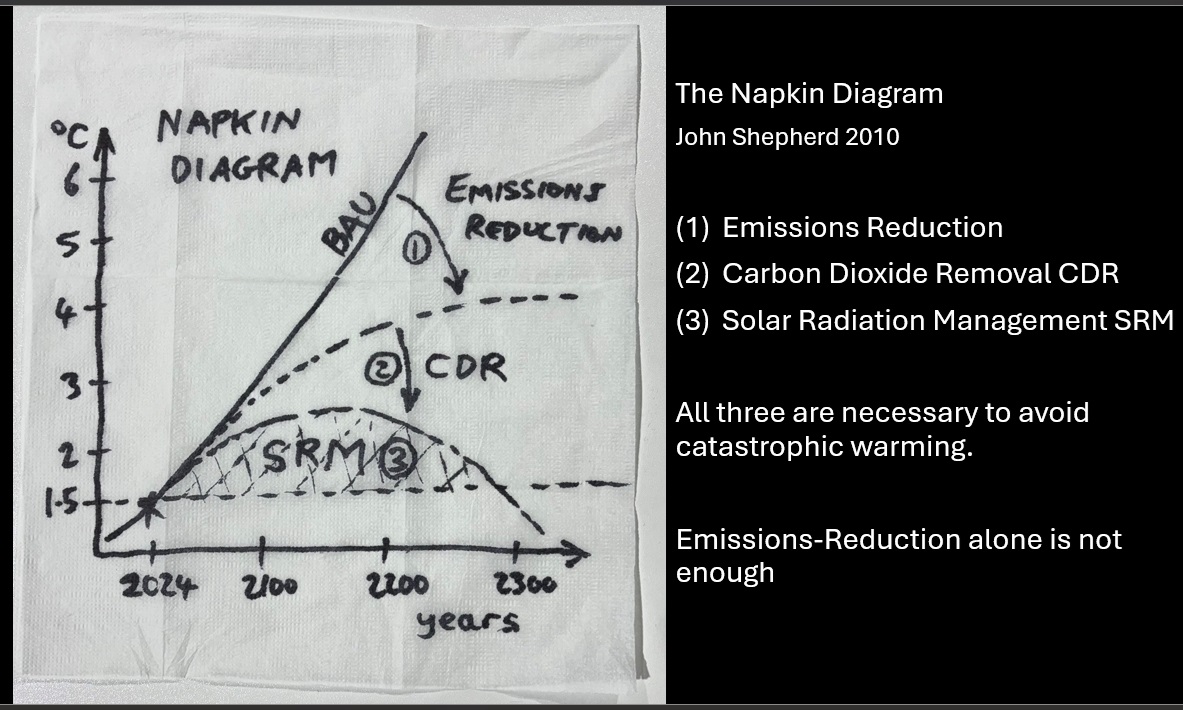
  • understand the timelines and stresses that we're facing as a result of climate change, and guided by The Napkin Diagram explore the options available to avert excessive global warming and arctic melting.
  • explore the literature of some of the Climate Repair techniques available and compare them in terms of their impacts, costs, scalability and social acceptability.
  • take one particular option for Climate Repair and carry out a detailed quantitative analysis and to perform a public consultation exercise.  Together these might be used to guide policy makers. 

Objectives

As specific objectives, by the end of the course students should be able to:

  • To explore the options for Climate Repair given that mitigation (ie Emissions reduction alone) is no longer sufficient to prevent irreversible changes to the climate, for instance melting of polar sea ice

Content

Climate change presents us with many challenges.  Mitigation (ie Emissions reduction alone) is no longer sufficient to prevent irreversible changes to the climate, for instance melting of polar sea ice. 

Negative emissions (Carbon Dioxide Removal CDR) is necessary but it too is not sufficient to deal with climate change in the short term.  Interventions known as "geoengineering" are likely to be necessary.  These include Solar Radiation Management (SRM) which is about enhancing the Earth's albedo - reflecting more light. 

The two most researched options are "Stratospheric Aerosol Injection" (SAI) and "Marine Cloud Brightening" (MCB).  The purpose of SRM is to keep temperatures low enough to prevent catastrophic climate change and to avoid irreversible tipping points.  It will "buy time" so that Mitigation and CDR will be given time to be implemented and to take effect.

FORMAT

Students work individually in Weeks 1 and 2, for which individual interim reports are submitted.  A more detailed evaluation of options in Weeks 3 and 4 is undertaken in groups of three, in which each student is responsible for a specific aspect of the chosen Climate Repair concept leading to a corresponding section of the final report.
Week 1
Familiarisation with the concept of the Napkin Diagram and developing an understanding of the range of Climate Repair options.  First interim report.
Week 2
Deep dive into a subset of geoengineering options and the formation of small teams to take a specific Climate Repair proposal forward.  Second interim report.
Weeks 3 & 4
Carry out detailed analyses of a particular Climate Repair option, including effectiveness, costs, scalability, impacts and public perception.  Prepare a report as if for a ministerial briefing.  Final report and group presentation.

Further notes

The NOAA website gives good background on SRM

https://www.climate.gov/news-features/understanding-climate/solar-radiat...


Also see the "Napkin Diagram"

https://www3.eng.cam.ac.uk/~hemh1/climate/napkindiagram.jpg

Coursework

Coursework Due date Marks

First Individual report

end week 1

15


Second individual report

end week 2

15

Second report  individual + team

final report

40 = 20+20


Examination Guidelines

Please refer to Form & conduct of the examinations.

 
Last modified: 11/11/2025 10:06

Engineering Tripos Part IIA Project, GG4: Neural Control with Adaptive State Estimation, 2025-26

Leader

Dr Flavia Mancini

Timing and Structure

Students work to their own schedule. A staffed "surgery" runs according to the lab timetable.

Prerequisites

Useful: 3F1 (Statistical Signal Processing), 3F2 (Systems and Control), 3F3 (Inference); Python vs. 3.12 (NumPy, Matplotlib, Jupyter)

Aims

The aims of the course are to:

  • To introduce students to simulation and control of partially observed dynamical systems.
  • To give practical experience with classical methods for state estimation.
  • To explore optimal feedback control in a closed-loop system.
  • To develop collaborative coding, analysis, and presentation skills.
  • To foster understanding of robustness in estimation and control under noise and model mismatch.

Objectives

As specific objectives, by the end of the course students should be able to:

  • Understand and apply state-space models to simulate dynamic systems.
  • Implement and tune models to decode noisy observations.
  • Design and use controllers for optimal state feedback control.
  • Integrate estimation and control in a closed-loop system.
  • Conduct experiments to assess tracking accuracy, control effort, and robustness.
  • Collaborate effectively to develop shared code and produce a joint presentation.
  • Present technical results clearly using plots, metrics, and structured reports.

Content

This lab explores how brain-machine interface (BMI)-like systems can decode noisy neural activity to control movement. In this design project, small groups will simulate and control a simplified neural interface system. A 2D cursor moves in a plane based on a latent trajectory, observed indirectly through noisy neural-like signals. Students will estimate the cursor's hidden state and control its movement toward a dynamic target. Over four weeks, they will explore estimation accuracy, control performance, and system robustness to disturbances and model mismatch. The project blends inference, control, signal processing, and neural data simulation in a realistic, design-oriented lab. 


Week 1–2 (Group) 

Introduction to classical filtering and control methods (primer provided). 

Groups set up simulation environment and run example trajectories. 

Implement group simulation code with documentation. 

Deliverable: Group simulation code + brief documentation (group mark); interim report (individual mark). 


Week 3 (Individual) 

Implement control loops. 

Test closed-loop performance and robustness. 

Continue experiments for final analysis. 


Week 4 (Group & Individual) 

Group presentation: approach, results, lessons learned (group mark). 

Individual final report due end of Week 4: methods, results, discussion (individual mark). 


Coursework

  • Group Simulation Code & Documentation (end of Week 1): 10 marks  
  • Individual Interim Report (end of Week 2): 20 marks 
  • Group Presentation (Week 4): 10 marks  
  • Individual Final Report (Week 4): 40 marks  


Examination Guidelines

Please refer to Form & conduct of the examinations.

 
Last modified: 24/04/2026 11:55

Engineering Tripos Part IIA Project, GF5: Animating 3D Characters, 2025-26

Leader

Dr E Wu

Timing and Structure

Fridays 9-11am plus afternoons, and Tuesdays 11-1pm

Aims

The aims of the course are to:

  • Introduce students to the core components of 3D character animation, including rigging, skinning, animation, and rendering
  • Provide hands-on experience with modern 3D graphics and animation tools
  • Give students practical exposure to building, animating, and rendering a 3D character model
  • As part of the project, students will capture an animatable 3D model of themselves and create a short animation

Objectives

As specific objectives, by the end of the course students should be able to:

  • Understand the concepts of skeleton-based rigging and skinning
  • Construct a simple rig for a 3D character and bind mesh geometry to the skeleton
  • Understand simple animation techniques such as keyframe interpolation
  • Capture a 3D human model and integrate it into an animation pipeline
  • Produce a short animated 3D scene with animated 3D characters

Content

Week 1

  • Introduction to 3D visualization and animation tools (using Python-based packages)
  • Overview of 3D meshes, skeletons, joints, skinning weights, and kinematic chains
  • Basic rig construction and skinning weights assignment on a simple 3D character
  • Implement forward kinematic transformations and pose the 3D character using Linear Blend Skinning (LBS)

Week 2

  • Create a simple animation sequence using keyframe interpolation
  • Render the animation into a 2D video
  • Individual interim report

Week 3

  • Load and animate a skinned 3D human model (SMPL)
  • Explore human motion sequences using the human model
  • Work in groups to capture 3D models of your team members
  • Drive your character models using existing motion sequences and produce animated motion clips

Week 4

  • Refine character animations and integrate them into a coherent 3D scene
  • Produce a 30-second long animation video featuring the virtual characters
  • Final group presentation and report

Coursework

Coursework Due date Marks
Interim report Friday 29 May 2026 (4pm) 20 (individual)
Interim animation results Friday 29 May 2026 (4pm) 5 (individual)
Final presentation Tuesday 9 June 2026 (11-1) 10 (group)
Final report Friday 12 June 2026 (4pm) 30 (50% individual, 50% group)
Final animation results
Friday 12 June 2026 (4pm) 15 (group)


Examination Guidelines

Please refer to Form & conduct of the examinations.

 
Last modified: 15/05/2026 01:16

Engineering Tripos Part IIA Project, GF4: Structure from Motion, 2025-26

Leader

Dr A Tewari

Timing and Structure

Thursdays 9-11am plus afternoons; and Mondays 11-1pm

Objectives

As specific objectives, by the end of the course students should be able to:

  • understand the principles of Structure from Motion, one of the most important algorithms in computer vision, through hands-on experimentation and implementation
  • explain the role of feature detection, feature matching, and camera pose estimation in an SfM pipeline
  • use a professional SfM tool such as COLMAP to reconstruct sparse 3D structure and camera poses from a set of images
  • design and analyse image-capture strategies for successful 3D reconstruction
  • implement key components of a simplified SfM pipeline in Python

Content

The aim of this project is to understand Structure from Motion through a combination of professional tools, mathematical foundations, and hands-on implementation. Structure from Motion is the process of recovering both the 3D structure of a scene and camera paraemeters from multiple overlapping images.

The project will begin by treating COLMAP as a professional reference system. Students will run COLMAP on both standard datasets and their own captured image sets, producing sparse reconstructions and visualising the estimated camera poses and 3D point clouds. They will perform controlled capture experiments to understand when SfM succeeds or fails, for example by varying the number of images, image overlap, texture, lighting, and camera motion. They will also inspect intermediate outputs such as detected keypoints and matched image pairs.

Students will then implement and analyse key steps of a simplified SfM pipeline in Python that includes feature detection, descriptor matching, and relative pose recovery. Modular utilities will be provided so that the focus remains on understanding and experimentation, rather than low-level software infrastructure.

The project culminates in a short group presentation and an individual final report, showcasing the reconstruction pipeline, visual results, quantitative and qualitative analysis, and lessons learned about the strengths and limitations of Structure from Motion.


Week 1:

  • setting up the Python/COLMAP environment and running COLMAP sparse reconstruction
  • visualising sparse point clouds and estimated camera poses
  • creating controlled ablations, such as fewer images, lower overlap, poor texture, or challenging lighting
  • reading introductory material on multiview geometry and SfM

Week 2:

  • extracting descriptors
  • matching descriptors between image pairs
  • estimating the fundamental matrix

Week 3:

  • recovering relative camera rotation and translation
  • triangulating sparse 3D points
  • visualising reconstructed sparse points and camera poses

Week 4:

  • analysing failure cases 
  • preparing and delivering final presentation and report.

Coursework

Coursework Due Date Marks
Interim Report 1 21 May 2026 15 (individual)
Interim Report 2 28 May 2026 15 (individual)
SfM code and Presentation 11 June 2026 30 (group)
Final Report 11 June 2026 40 (individual)


Examination Guidelines

Please refer to Form & conduct of the examinations.

 
Last modified: 10/05/2026 19:36

Engineering Tripos Part IIB, 4B29: Wireless Communication, 2025-26

Module Leader

Prof OB Akan

Timing and Structure

Lent term. 75% exam / 25% coursework

Prerequisites

3B2 and 3F4 useful

Aims

The aims of the course are to:

  • Provide an in-depth understanding of wireless communication systems, covering both fundamental principles and advanced methodologies, including the challenges and demands faced by modern wireless communication technologies.
  • Explore the evolution of wireless communication, from traditional systems to advanced technologies like 6G, and examine how wireless communication has transformed society, influencing how people live, work, and interact through ubiquitous networks such as
  • Equip students with the tools to understand key concepts in wireless systems, such as signal propagation, channel models, and path loss, establishing a strong foundation to evaluate and design complex wireless systems.
  • Delve into statistical channel analysis, diversity techniques, and advanced methods for optimizing communication efficiency. This includes applying techniques such as Maximal Ratio Combining (MRC), Equal Gain Combining (EGC), and OFDM, and focusing on optim
  • Investigate multicarrier systems, including the application of OFDM, NOMA, and spread spectrum techniques, and explore their use in modern wireless communications, preparing students for the latest trends such as 6G technologies, Integrated Sensing and Co
  • Prepare students to design, analyze, and optimize wireless systems by providing a comprehensive understanding of wireless communication technologies. This enables students to address real-world challenges through practical applications of OFDM, MIMO, and

Objectives

As specific objectives, by the end of the course students should be able to:

  • Develop a strong foundation in wireless communication systems, focusing on concepts such as signal propagation, channel models, path loss, and shadowing effects. Understand how these principles apply to the design and evaluation of communication systems an
  • Analyze wireless channel models, including statistical models for Narrowband fading, Markov channels, and wideband channels. Assess the impact of delay spread, Doppler shift, and capacity in various channel conditions (e.g., AWGN, flat fading, and frequen
  • Explore diversity techniques such as MRC, EGC, adaptive modulation and coding, and Alamouti coding. Implement these techniques to improve system reliability and data transmission rates, while also understanding their performance in diverse channel conditi
  • Master multiple-antenna systems, including MIMO, massive MIMO, and beamforming techniques, essential for modern communication systems. Apply these techniques to improve signal reception, transmission efficiency, and system capacity.
  • Investigate advanced techniques, such as OFDM, NOMA, and spread spectrum techniques (DSSS, FHSS), to optimize wireless communication systems. Apply the knowledge of OFDM in multicarrier systems to handle high-data-rate wireless transmission, particularly
  • Understand emerging wireless technologies such as ISAC, Reconfigurable Intelligent Surfaces (RIS), Terahertz communications, and gain insights into how these technologies will be integrated into next-generation networks like 6G.
  • Apply these concepts in practical scenarios through coursework that focuses on the design and implementation of systems like OFDM and basic communication technologies for real-world applications. This hands-on approach will provide students with valuable

Content

Introduction to Wireless Communications & Channel Models (2L)

  • Overview of wireless communications and channels
  • Signal propagation
  • Tx/Rx signal models
  • Path loss models and shadowing effects
  • Combined path loss/shadowing models
  • Coverage area in cellular systems

Statistical Channel Models and Capacity (2L)

  • Statistical wireless channel models
  • Narrowband fading models
  • Markov channel
  • Wideband channel models
  • Delay spread and Doppler
  • Capacity of wireless channels: capacity in AWGN, flat and FS fading channels

Diversity Techniques (2L)

  • Diversity techniques overview
  • MRC and EGC diversity
  • Transmit diversity
  • Adaptive modulation and coding

Multiple-Antenna Systems and Beamforming (2L)

  • Multiple-antenna wireless communications
  • MIMO channel capacity and diversity
  • Massive MIMO
  • Beamforming
  • mmWave Beamforming

Multi-carrier Systems & Spread Spectrum Techniques (2L)

  • Time, Frequency, and Code Division Multiple Access (TDMA, FDMA, CDMA)
  • Multicarrier Systems, OFDM, and other multi-carrier waveforms
  • NOMA System
  • Frequency domain equalization
  • Spread spectrum techniques (DSSS, FHSS)
  • RAKE receivers

Advanced Topics and Applications (2L)

  • Multi-user systems and Cellular Systems
  • 6G roadmap and key technologies
  • Integrated Sensing and Communications (ISAC)
  • Reconfigurable Intelligent Surfaces (RIS)
  • Terahertz (THz) wireless 
  • Space communications

Examples papers

Two example papers will be issued with an example class for each example paper.

Coursework

For the coursework there will be a design exercise worth 25%. Since the coursework will assess OFDM design, OFDM design will not be assessed in the end of year examination.

Advanced OFDM System Design, CFO Estimation and Correction for 5G and Beyond Wireless Communications

In this project, you will design and implement an OFDM-based communication system for 5G wireless networks, with a specific focus on Carrier Frequency Offset (CFO) estimation and correction. The project will be conducted in two phases: first, simulating the OFDM system and CFO estimation/correction techniques in MATLAB/Python, followed by real-time transmission and performance evaluation using the ADALM Pluto SDR platform. You will investigate the impact of CFO on system performance and develop optimization strategies to improve signal quality and system reliability in real-world conditions. Through this coursework, you will gain valuable insights into how advanced synchronization techniques enhance the robustness and efficiency of wireless communication systems. Additionally, this project will provide a foundation for understanding the critical role of synchronization in future 6G networks, where addressing challenges such as CFO will be essential for supporting massive device connectivity and ensuring seamless communication in complex environments.

Learning objectives:

  • Simulate a 5G OFDM with key physical layer parameters (subcarrier spacing, FFT size, cyclic prefix, and modulation schemes) in MATLAB/Python.
  • Configure and operate the ADALM Pluto SDR for real-time transmission and reception of OFDM signals.
  • Implement Carrier Frequency Offset (CFO) estimation and correction techniques on real-world IQ data captured from the SDR platform.
  • Evaluate system performance by measuring Bit Error Rate (BER), Signal-to-Noise Ratio (SNR), and throughput before and after CFO correction under AWGN, Rayleigh fading, and Doppler shifts in a hardware-in-the-loop environment.
  • Develop a comprehensive understanding of synchronization challenges and mitigation strategies in SDR-based 5G wireless communication systems.

Format

The report should be no more than 10 sides of A4 with minimum font size of 11. Individual report anonymously marked. 

Due date & marks

Wednesday of  Week 9,  [15/60].


Examination Guidelines

Please refer to Form & conduct of the examinations.

 
Last modified: 05/06/2025 18:16

Engineering Tripos Part IIA, 3D9: Construction Management, 2025-26

Module Leader

Prof Ioannis Brilakis

Lecturer

Prof Ioannis Brilakis

Lab Leader

Prof Ioannis Brilakis

Timing and Structure

Michaelmas term, 16 lectures

Aims

The aims of the course are to:

  • Familiarise students with core methods and principles for managing construction projects and businesses.
  • Introduce planning, scheduling, monitoring, productivity, road earthworks, and risk techniques.
  • Understand the fundamentals of Building Information Modelling and Digital Twins
  • Explore procurement, contracts, health and safety, and sustainability in a construction context.

Objectives

As specific objectives, by the end of the course students should be able to:

  • Grasp the key challenges associated with managing major construction projects.
  • Implement lean construction and production management techniques effectively.
  • Analyse various bidding strategies and procurement methods.
  • Design appropriate organizational structures and ownership models tailored to different construction environments at local, national, and international levels.
  • Utilize Building Information Modelling (BIM) and Digital Twins for planning, simulation, and project management.
  • Grasp the significance of information management in the construction industry.
  • Identify risks, explore organizational structures, and understand the implications of contract law.
  • Learn the basics of health, safety, and wellbeing within the construction sector.
  • Understand earthworks balancing and logistics for roadway projects.

Content

This module equips students with the essential concepts and tools for managing construction operations and companies. The content spans project scheduling, productivity, digital tools (BIM and Digital Twins), sustainability, procurement, safety, and legal aspects. Emphasis is placed on UK-based civil engineering and building projects, supported by expert industry lectures and lab-based digital simulations. 
 
Project & information management (6L) 2 lectures/week, weeks 1-3
 
Introduction, roles & responsibilities 
 
Project scheduling 
 
Project monitoring 
 
Productivity improvement, workforce motivation & agile management 
 
Building Information Modelling 
 
Digital Twins  


Production management (6L) 2 lectures/week, weeks 4-6
 
Lean & Sustainable Construction 
 
Earthworks Fundamentals 
 
Soil Excavation 
 
Rock Excavation 
 
Loading and Hauling 
 
Health, Safety, Wellbeing, and risk management 


Business management (4L) 2 lectures/week, weeks 7-8
 
Procurement & Partnering 
 
Construction contract law 
 
Estimating, tendering & competitive bidding 
 
Business methods, organisational structures 

Examples papers

Three example papers related to the lecture course will be distributed by the end of each section of the module. Please check the 3D9 Moodle page for updates. 

Coursework

Labs focusing on BIM-based planning and scheduling will take place in the DPO. The sign-up page (https://teachapp.eng.cam.ac.uk/cuedle2/index.php?context=3D9sa2194) will be activated at the beginning of Michaelmas. Lab reports must be submitted on the 3D9 Moodle page within 15 days following the lab session.
 
Learning objectives:  
 
To gain first-hand experience in applying BIM for construction planning and scheduling. 
 
To simulate and visualise construction workflows using digital tools. 
 
To understand the integration of design and schedule data through 4D modelling. 
 
To evaluate construction sequencing, resource allocation, and project constraints in a virtual environment. 
 
To develop skills in interpreting and manipulating project information in a digital format. 
 
To recognise the practical benefits and limitations of BIM-based construction management systems. 
 
Practical information: 
 
Lab sessions will take place in the DPO. 
 
This activity doesn't involve preliminary work, but it will be beneficial to read the handouts beforehand. 
 
 
Full Technical Report: 
 
There is no Full Technical Report (FTR) associated with this module.  

Booklists

Please consult the Booklist for Part IIA Courses for references pertinent to this module, which can be accessed on the associated Moodle course.  
 
 
The library booklist for this module includes: 
 
Core Reading:
1. HARRIS, F., McCAFFER, R., BALDWIN, A., and EDUM-FOTWE, F. (2021)
MODERN CONSTRUCTION MANAGEMENT, Wiley Blackwell. 
 
2. Nunnally, S. W. (2014)
Construction Methods and Management. 8th Edition, Pearson New International Edition.
ISBN: 9781292039350
 
3. Parn et al. (2024)
Twin Systems: Digital Twins of the Built Environment
ISBN: 9782634541210
 
4. Alavi H., et al. (2024)
Integrated Building Intelligence. 1st Edition. Springer Cham.
ISBN (eBook): 9783031688645
 
Further Reading:
1. Sacks R., et al. (2018)
BIM Handbook: A Guide to Building Information Modeling for Owners, Designers, Engineers, Contractors, and Facility Managers 
ISBN: 9781119287537
 
2. Gransberg, D.D., Popescu, C.M., & Ryan, R.C. (2020)
Construction Equipment Management for Engineers, Estimators, and Owners. 2nd Edition. CRC/Taylor & Francis.
ISBN: 978-1498788502
 
3. Patricia T. et al. (2018)
Lean Construction: Core Concepts and New Frontiers
ISBN: 9781032919676
 
4. SEARS, S.K., et al., (2015)
CONSTRUCTION PROJECT MANAGEMENT, 6th edition, Wiley Blackwell.
 

Examination Guidelines

Please refer to Form & conduct of the examinations.

UK-SPEC

This syllabus contributes to the following areas of the UK-SPEC standard:

Toggle display of UK-SPEC areas.

GT1

Develop transferable skills that will be of value in a wide range of situations. These are exemplified by the Qualifications and Curriculum Authority Higher Level Key Skills and include problem solving, communication, and working with others, as well as the effective use of general IT facilities and information retrieval skills. They also include planning self-learning and improving performance, as the foundation for lifelong learning/CPD.

IA1

Apply appropriate quantitative science and engineering tools to the analysis of problems.

KU1

Demonstrate knowledge and understanding of essential facts, concepts, theories and principles of their engineering discipline, and its underpinning science and mathematics.

KU2

Have an appreciation of the wider multidisciplinary engineering context and its underlying principles.

D1

Wide knowledge and comprehensive understanding of design processes and methodologies and the ability to apply and adapt them in unfamiliar situations.

S1

The ability to make general evaluations of commercial risks through some understanding of the basis of such risks.

S3

Understanding of the requirement for engineering activities to promote sustainable development.

S4

Awareness of the framework of relevant legal requirements governing engineering activities, including personnel, health, safety, and risk (including environmental risk) issues.

E1

Ability to use fundamental knowledge to investigate new and emerging technologies.

E2

Ability to extract data pertinent to an unfamiliar problem, and apply its solution using computer based engineering tools when appropriate.

E3

Ability to apply mathematical and computer based models for solving problems in engineering, and the ability to assess the limitations of particular cases.

P1

A thorough understanding of current practice and its limitations and some appreciation of likely new developments.

P3

Understanding of contexts in which engineering knowledge can be applied (e.g. operations and management, technology, development, etc).

US1

A comprehensive understanding of the scientific principles of own specialisation and related disciplines.

US3

An understanding of concepts from a range of areas including some outside engineering, and the ability to apply them effectively in engineering projects.

 
Last modified: 09/04/2026 09:34

Engineering Tripos Part IIA Project, SB4: Modeling of integrated photonic components, 2025-26

Leader

Dr Q Cheng

Aims

The aims of the course are to:

  • Understand Fundamental Theories: Gain a solid understanding of key concepts in photonics, including Maxwell's equations, waveguides, modes, FDTD models, and boundary conditions.
  • Master Eigenmode Analysis: Learn to solve for eigenmodes in silicon waveguides using theoretical methods and Lumerical FDTD, and understand their physical significance.
  • Develop Proficiency in Photonic Simulations: Acquire hands-on experience with Lumerical FDTD to set up, run, and analyze simulations, including basic waveguides and complex photonic components.
  • Design, Simulation, and Validation: Gain the ability to design, simulate, and analyze photonic components such as directional couplers and MMIs, and validate simulation results by comparing them with mathematical models.

Objectives

As specific objectives, by the end of the course students should be able to:

  • Understand the working principles and simulation methodologies for two key photonic components — directional couplers and multimode interferometers (MMIs), including mode coupling theory and multimode interference.
  • Design and simulate a 2x2 directional couplers and a 2x2 MMI, optimizing their performance metrics such as coupling efficiency, insertion loss, and bandwidth.
  • Validate simulation results by comparing them with analytical models and numerical methods, ensuring accuracy and reliability in predicting device behavior and performance. Discuss the current design limitation and possible improvement.
  • Apply acquired knowledge and skills to practical scenarios, preparing for advanced studies or professional applications in photonics, such as communications, sensing, and signal processing.

Content

This four-week course on photonics simulation, designed for bachelor students, provides a comprehensive introduction to both theoretical and practical aspects of photonics. The course begins with an overview of fundamental photonics concepts, including Maxwell's equations, waveguides, and eigenmodes. Students will learn to derive waveguide modes using Maxwell’s equations and perform basic simulations.

In the second week, students will delve into eigenmode and mode propagation analysis in silicon waveguides, and design a single-mode waveguide utilizing both theoretical calculations and Lumerical FDTD simulations. This will provide a deeper understanding of mode characteristics and behavior in silicon waveguides.

The third week focuses on the design of two photonic components, i.e. a directional coupler and a MMI. Students will calculate key structural parameters and construct initial simulations of these components, gaining practical experience in photonic design and simulation techniques.

In the final week, students will optimize the performance of the designed components and validate their simulation results with mathematical models to ensure accuracy and reliability in their simulations. By the end of the course, students will be proficient in both the theoretical understanding and practical application of photonics simulations, preparing them for advanced studies or professional work in the field.


Week 1

Introduce fundamental photonics theory and basic waveguide simulation with Lumerical software, focusing on understanding and setting up simple models. 

Week 2

Dive into eigenmode analysis in silicon waveguides using both theoretical calculations and Lumerical FDTD. Design and simulate a single-mode waveguide, observe the mode propagation, and compare it with the calculated single-mode condition.

Week 3

Design and simulate two waveguide photonic components — a directional coupler and an MMI. Calculate their key structural parameters using theoretical models, and simulate both components with Lumerical FDTD.

Week 4

Validate simulation results by comparing them with theoretical and numerical models, optimize their performance, ensuring accuracy and reliability of the simulations. 

Mini Lectures:

Two mini lectures will be delivered to:

•Introduction to photonic fundamentals, Maxwell's equations, waveguide modes, and eigenmode analysis in photonic waveguides, such as silicon waveguide.
•Overview/tutorial of Lumerical FDTD software, including interface navigation, setting up simulations, and running and interpreting simulation results.

Coursework

Coursework

Due date

Marks

Interim report 1

TBD

15

Interim report 2

TBD

15

Final summary report

TBD

50


Examination Guidelines

Please refer to Form & conduct of the examinations.

 
Last modified: 01/12/2025 07:18

Engineering Tripos Part IIB, 4M29: Designed to Lead, 2025-26

Leader

Ms K Lanucha

Timing and Structure

Michaelmas term. 100% coursework

Prerequisites

None

Aims

The aims of the course are to:

  • Developing essential leadership competencies through reflecting, exchanging ideas, and holding each other accountable for progress.

Objectives

As specific objectives, by the end of the course students should be able to:

  • Enhance adaptability and resilience as a leader in the face of volatility, uncertainty, complexity, and ambiguity.
  • Increase self-awareness and recognise the impact of emotions on leadership effectiveness.
  • Develop skills to manage and regulate emotions in oneself and others.
  • Enhance empathy and interpersonal relationships to foster a positive work environment.
  • Understand the key elements of a high performing team and their importance.
  • Acquire fundamental coaching techniques to support the growth and development of individuals.
  • Learn effective questioning and active listening skills to facilitate self-discovery and problem-solving.
  • Understand the importance of diversity and inclusion in leadership and its impact on team performance.
  • Learn strategies to create an inclusive work environment that values and leverages diverse perspectives.
  • Develop skills to build strong relationships and networks to support successful influence.

Content

The consists of a series of 7 seminars spread over a trimester.

Designed to Lead

One 2-hour weekly seminar for 7 weeks


Week 1 - Introductory session 

In our opening week, students will dive into the fundamentals of the course, providing them with a roadmap, essential information about designing their development plan, and engaging ice-breakers to set the tone for a collaborative and enriching learning experience.


Week 2- Leadership skills for VUCA (volatile, uncertain, complex and ambiguous work environment) 

This session will be focusing on a deep exploration of leadership skills tailored for the VUCA world—where volatility, uncertainty, complexity, and ambiguity reign. Focus: the essential skillset required to navigate and lead in this dynamic global environment, where adaptability is the only certainty.


Week 3 - Emotional intelligence

This session invites students to explore the realm of emotional intelligence, help them uncover the nuances of understanding oneself and cultivating robust relationships with team members. Students will reflect on their individual work preferences, explore diverse communication styles, and harness empathy to construct bridges between colleagues.


Week 4 - Culture of high performing teams 

This session will be focusing on the dynamics of high-performing teams. Students will delve into the key characteristics that define success, with a particular focus on psychological safety. Focus: understanding the pivotal role leaders play in fostering an environment of safety, vulnerability, and shared goals.


Week 5 - Coaching skills

This session will be focusing on how to develop coaching skills to support team members' growth and development. Students will learn about the GROW model of coaching (Goal, Reality, Options, Will. Students will hone their abilities in active listening, master questioning techniques, and refine their feedback.


Week 6 - Inclusive leadership

This session introduces the importance of inclusive leadership. Students will reflect on the business case for cognitive diversity and explore strategies to cultivate an inclusive workplace culture. This session will equip them with the skills to champion diversity and promote an environment where everyone's voice is heard.


Week 7 - Influencing skills

In this session, the focus will be on the power of influence. Students will sharpen their skills with a focus on confident body language, both online and in-person. They will learn about the subtleties of non-verbal and paraverbal communication to enhance their ability to inspire and others.


Week 8 – Individual sessions

Examples papers

N/a

Coursework

The module is assessed using a reflective portfolio.

In the first seven weeks of the module, students must submit seven reflective pieces (between 200 and 300 words each week) on Moodle (in an OU blog).

In week 8, students must submit a development plan (800-1000 words) as an assignment via Moodle. For the assignment, students will need to:

1. Reflect on their learning from the course. This can be done using a model such as Gibbs’ Reflective Cycle. Details on this model and how it can be applied will be provided in class.

2. Drawing from the above, students will identify how to apply the learning by drafting their development plan. This plan needs to outline the key areas they have identified for development, explain why they are of personal benefit and define specific, measurable, achievable, relevant and time-bound (SMART) actions to achieve their goals.


Examination Guidelines

Please refer to Form & conduct of the examinations.

 
Last modified: 04/06/2025 13:33

Engineering Tripos Part IIB, 4B28: Very large scale integration (VLSI), 2025-26

Leader

Dr M Tang

Lecturer

Dr M Tang

Timing and Structure

Michaelmas term. 75% exam / 25% coursework

Prerequisites

3B2 assumed, 3B5 useful.

Aims

The aims of the course are to:

  • provide fundamental knowledge and analytical skills required for VLSI systems design in the nanometre era
  • illustrate the importance of custom design tools and also electronic design automation (EDA) for physical implementation, testing and verifications of VLSI systems

Objectives

As specific objectives, by the end of the course students should be able to:

  • be familiar with the modern CMOS fabrication process, physical layout design rules and anticipate trends in VLSI fabrication technologies
  • understand the trade-off between the four key design metrics of modern VLSI systems – cost, reliability, speed and power
  • recognise the parasitic effect of wires/interconnects and apply wire delay models like lumped RC model and Elmore delay model
  • understand the sources of power dissipation and the factors affecting robustness of a VLSI system
  • design and optimise multi-level CMOS combinational and sequential circuits using static logic, pass transistor logic and dynamic logic
  • operate up-to-date design tools for VLSI systems and evaluate the quality of the outputs (e.g. floorplan, placement, routing, verification, etc.)

Content

The module will introduce the design principles of integrated circuit designs with millions of digital devices. It begins with CMOS design flows and fabrication processes that creates modern VLSI and explains the design metrics (performance, power, cost, reliability). The typical combinational and sequential circuit design styles like static logic, pass transistor logic and dynmaic logic will be illustrated with many examples of digital devices. The effect of wires and interconnects on circuit speed and power will be studied. The module will be concluded with a case study of cutting-edge advanced VLSI technologies (e.g. FinFET) and design techniques.

Design Flow and Metrics (1L)

  • Design flow: design, synthesis, planning, implementation, fabrication
  • Cost: yield and detects of wafer die
  • Reliability: noise margins, regenerative property of digital circuits
  • Speed: delay definition, Fanout-of-four (FO4) delay
  • Power: instantaneous, average, peak

CMOS Fabrication and Layout Design Rules (1L)

  • Fabrication process: substrate preparation, photolithography, doping and diffusion, oxidation, packing
  • Design rules: micron rules vs scalable rules, CMOS process layers, stick diagrams (sketch)

CMOS inverters and static gates (2L)

  • CMOS I-V equations, velocity saturation in deep sub-micron devices
  • Source and model of parasitic capacitances
  • DC analysis of CMOS inverters
  • Equivalent resistance model
  • Logic gate design using switch model

Wires and Interconnects (1L)

  • Interconnect parameters: capacitance, resistance and inductance
  • Wire models: lumped model, lumped RC model, Elmore delay model
  • Distributed RC line

High-speed Logic Design and Logical Effort (1L)

  • Delay of logic gates
  • Derivation of intrinsic delay and logic effort
  • Optimisation for buffer sizing and the number of buffer stages
  • Branching Effort

CMOS Sequential Circuit Design, Clocking (2L)

  • Static latches, flip-flops, and registers
  • Dynamic designs: C2MOS register and TSPC latch
  • Clock tree and clocking strategies

Electronic Design Automation (EDA) tools for VLSI (1L)

  • Synthesis: logic circuit modelling, timing models
  • Placement: principles and challenges
  • Routing: principles and challenges

Power and Robustness (1L)

  • Dynamic power disspation
  • Static comsumption
  • Power analysis and optimisation technique
  • Signal integrity issues

Packaging, I/O and Electrostatic Discharge Protection (1L)

  • Common VLSI packaging options and issues
  • Input and output (I/O) pad and buffer design
  • Tri-state buffers

Advanced VLSI Technology and Design Techniques (e.g. FinFET, 3D stacking) (1L)

  • Topics varies every year, suggestions from students are welcome.

Coursework

Students are provided with a reference design in hardware description language (VHDL, Verilog or SystemVerilog), for instance an Arithmetic and Logic Unit (ALU) circuit. They will be asked to complete the semi-automatic design flow based on up-to-date Process Design Kit (PDK). During the process, they will be instructed to inspect and analyse results and reports from the various design automation tools. They may be able to verify the final physical layout of the reference design.

This activity involves preliminary work (~2h). You are required to read the lab handouts before lab sessions and be familiar with the usage of various design tools for this activity.

A total of 16 hours (including preliminary work) is required to complete this coursework.

Students will have the option to submit a Full Technical Report.

Submission and Assessment

The student will be asked to submit a technical report that summarises the experimental procedures, results and personal reflections on the lab exercises. In addition, the students will have to submit supporting documents (logbook, generated files, screen captures) as evidence of successful experiments.

Learning Objectives:

  • Gain experience with VLSI/ASIC design tools (e.g. Cadence design tools)
  • Practise a semi-custom design flow for VLSI/ASIC (synthesis, floorplan, place and routing, timing analysis)
  • Verify a physical design (optional)

Booklists

  • (Core) Analysis and design of digital integrated circuits: in deep submicron technology, David A. Hodges, Horace G. Jackson, Resve A. Saleh., 3rd ed, ISBN: 0072283653
  • (Recommended) Rabaey, Chandrakasan and Nikolic, Digital Integrated Circuits, 2nd ed, ISBN-13: 978-0130909961
  • (Recommended) Weste and Harris, CMOS VLSI Design, 4th ed, ISBN-13: 978-0321547743


Examination Guidelines

Please refer to Form & conduct of the examinations.

 
Last modified: 04/06/2025 13:26

Engineering Tripos Part IIA Project, SF5: Networks, friendship, and disease, 2025-26

Leader

Dr G Cantwell

Timing and Structure

Friday 11-1, Tuesday 9-11 plus afternoon

Aims

The aims of the course are to:

  • To understand and apply concepts from the study of networks.
  • Familiarity with the basics of discrete maths and graph theory.
  • To run simulations of social networks and to link ideas from probability theory to these simulations.
  • To implement graph algorithms and appreciate the need for computational efficiency.

Content

Networks can represent the structure of many different things, from technological networks to social networks to biological networks. This project introduces the field of network science. Students will learn about the mathematics that underpins the study of networks. They will explore how ideas from probability theory and stochastic processes can be applied to understand the structure of friendships. They will write software to simulate disease spreading in a network. Finally, the results from different simulations will be explored to establish mathematical insight about the relationship between network structure and spreading processes.


Week 1

Mathematics of networks.

Week 2

Heterogeneity and the friendship paradox.

Week 3

Simulating spreading processes in networks.

Week 4

Linking heterogeneity with the spread of disease.

Coursework

Coursework Due date Marks

Interim report 1

  15

Interim report 2


15

Final report

4pm, Friday 7 June 2024

50


Examination Guidelines

Please refer to Form & conduct of the examinations.

 
Last modified: 01/12/2025 07:28

Pages

Subscribe to 2025-26