Undergraduate Teaching 2025-26

2025-26

2025-26

Not logged in. More information may be available... Login via Raven / direct.

Engineering Tripos Part IIA Project, GB2: Electrical Power, 2025-26

Leader

Dr S Goetz

Timing and Structure

Thursdays 11-1pm and Mondays 9-11am plus afternoons

Prerequisites

3B3

Aims

The aims of the course are to:

  • To introduce the techniques of conceptual design process.
  • To introduce and develop methods for optimising designs through iteration of design equations.
  • To gain an appreciation of the factors influencing power component designs.
  • To have hands-on experience on developing and testing power electronic apparatus by prototyping AC/DC and DC/DC converters

Objectives

As specific objectives, by the end of the course students should be able to:

  • Understanding the requirement specification and having an appreciation of technical challeges
  • Identifying specific tasks for each group member and managing teamwork porgress
  • Having practice on making power electronic circuits, including modelling, device selection, gate drive circuitry, coding and digital controller implementation, passive components design and making.
  • Having practice on testing power electronic circuits, including instrumentation, sense for measurement

Content

This project will involve students in a wide variety of design issues within electrical engineering. Included are circuit design using integrated circuits, power semiconductor device circuits and the design of a transformer suitable for use with non-sinusoidal supplies.

A tight specification will be given for a prototype 24V dc to 230V ac (50Hz), 150W inverter for use as an emergency power supply in the event of mains failure. Simple calculations for the designs of each stage will be iterated such that a satisfactory solution is obtained. A complete inverter will be made by each group and thoroughly tested to establish whether it meets the specification.

Student will have excises in circuit modelling (LTSpice, PLECS) and PCB design (KiCAD). 

This project will offer students experience and skills for power electronics hardware development. Real power electronic devices and their applications and features will be introduced. 

Aims:

Technical interpretation and design specification

•Understand the general requirements and transfer them to technical specifications
•Define design requirements: ratings, architecture, bill of materials (BoM), high frequency transformer design

Applications notes and datasheet

•Fill the gap between theories and realisation by using application notes and datasheet
•Find and understand important parameters from datasheet


Week 1

Conceptual design (Group report 1).

Week 2

Design and build converter circuits for dc to dc and ac to dc conversion

Week 3

Test converter circuits and integrate (Group report 2).

Week 4

Final assembly and test (Individual final report).

MINI LECTURES

Three or four mini lectures will be presented covering:

  • Introduction to circuit topologies
  • Transformer design.
  • Introduction to power semiconductor devices.
  • Introduction to power semiconductor device gate drive circuitry 

Circuits and methods

A detailed handbook and a collection of datasheets is given to each student. One practical design is outlined but there is no bar to using other designs if they are sensible. The datasheets are distributed simply to help with the conceptual design stage and no limit is placed on the availability of components. Following the conceptual design report, students may be encouraged or otherwise from following a particular path. Hence it may be expected that each group will produce a working inverter. Use of computers is encouraged, particularly for optimisation of the transformer design. Good quality general purpose electrical and electronic engineering facilities are available.

Coursework

Coursework Due date Marks

Interim report 1 

TBA

15

Interim report 2 

TBA

25

Final report 

4pm Thursday 18 June 2025

40


Booklists

Recommeded: 

https://www.onsemi.com/pub/Collateral/AN-6076.pdf

https://www.fairchildsemi.com/application-notes/AN/AN-6076.pdf

http://www.ti.com/lit/ml/slua618/slua618.pdf


Examination Guidelines

Please refer to Form & conduct of the examinations.

 
Last modified: 01/12/2025 07:14

Engineering Tripos Part IIA Project, GB1: Optical Fibre Link, 2025-26

Leader

Prof T D Wilkinson

Timing and Structure

Thursday 9-11, and afternoons and Monday 11-1

Prerequisites

3B1 & 3B2 essential

Aims

The aims of the course are to:

  • To provide practical experience of electronic circuit design and construction
  • To provide experience of using optoelectronic devices and their applications.
  • To a build communications system including testing and characterisation

Content

The aim of the project is to design and build a complete communications link based on a plastic optical fibre and resonant cavity light emitting diode that is capable of delivering up to 10 Mbit/s data rates.  The challenge is to build a working  transmitter, receiver and full testing scenario using a limited set of components within the EITL. Each element of the link has to be fully tested and characterised before putting them together as an overall system capable of transmitting digital data from a compact disk player.  Students work in groups of three to design, construct and test an optical communications system. Each student within a group will be expected to manage the different sections of the design and construction individually and then combine them as a group into an overall communications system. All reports are submitted individually and will contain both individual and group elements as the project design ideas develop.

Week 1

System outline and basic transmitter, receiver and testing scenario. First interim report.

Week 2

Reciver, transmitter and tesct scenario construction.  Characterisation and fault finding. Second interim report.

Week 3

System test integration and general testing. Optional extension design/construction.

Week 4

Final testing and CD demonstration of overall systems along with extensions. Final report.

MINI-LECTURES

Mini-lectures on optical communication system design and circuit design for the basic building blocks will be integrated into the first week of the project.

Coursework

Coursework Due date Marks

Interim report 1


TBA

15

Interim report 2

TBA

15

Final summary report

4pm Thursday 7 June 2023

50

  Approximately 30% or marks are  based on group work and 70% on individual elements.  


Examination Guidelines

Please refer to Form & conduct of the examinations.

 
Last modified: 01/12/2025 07:13

Engineering Tripos Part IIA Project, GA4: Heat Pump, 2025-26

Leader

Prof A J White

Timing and Structure

Fridays 11-1pm, Tuesdays 9-11am plus afternoons

Prerequisites

3A5 useful

Aims

The aims of the course are to:

  • To critically assess the value of heat pump technology as a way of reducing emissions of CO2.
  • Undertake measurements (including some instrumentation and data processing design) to assess the performance of a heat pump.
  • Produce a Python model of the heat pump which is validated against the experimental measurements.
  • Model and understand how an Air Source Heat Pump (ASHP) operating in a typical house over the course of a year.

Content

The descriptions below and the lists of tasks / reports are based on the 2025 project and may be modified slightly for the coming year

This project looks at the performance of a commercially available heat pump for domestic heating applications. Students will be required to modify and design some instrumentation and undertake experiments to measure the performance of a commercial heat pump. They will also create a Python model of the heat pump cycle. Either the Python model or information extracted from the exeperiments can then be used to model how an Air Source Heat Pump will perform over the course of a year for heating a typical dwelling, taking account of weather variations. 

Students will work in groups of 4 to modify the heat pump rig, design and calibrate some instrumentation and perform the experiments. Individual tasks may be distributed amongst group members as decided by the group. The first report is a group report (6 pages) and the final report (8 pages) is to be written individually. Students also submit their Python script individually and this will be tested and marked.

This project looks at the performance of a commercially available heat pump for domestic heating applications. Students will be required to modify and design some instrumentation and undertake experiments to measure the performance of a commercial heat pump. They will also create a Python model of the heat pump cycle. Either the Python model or information extracted from the exeperiments can then be used to model how an Air Source Heat Pump will perform over the course of a year for heating a typical dwelling, taking account of weather variations. 

Students will work in groups of 4 to modify the heat pump rig, design and calibrate some instrumentation and perform the experiments. Individual tasks may be distributed amongst group members as decided by the group. The first report is a group report (6 pages) and the final report (8 pages) is to be written individually. Students also submit their Python script individually and this will be tested and marked

Weeks 1 & 2

  • Familiarisation with the equipment.
  • Design, build and calibration of flow measurement device.
  • Writing data processing code in Python
  • Commence Python thermodynamic cycle model
  • Undertake heat pump measurements
  • Submit group report on experimental work

Weeks 3 & 4

  • Complete and submit Python model of heat pump cycle (individually)
  • As a group, develop a model of a heat-pump system - including the the dwelling
  • As a group, undertake calculations of how a heat pump performs over a typical year
  • Undertake (primarily individually) some further investigation, which may be experimental, modelling or literature based.
  • Submit individual final report

Coursework

Coursework Due date Marks

Interim Report 1 (group)

TBC (End of week 2)

25
(group)

Submission of Python script (individual)

TBC (Middle of week 3)

15

(individual)

Final Report (individual but with some group components)


Friday 9 June 2023

40

(individual)


Examination Guidelines

Please refer to Form & conduct of the examinations.

 
Last modified: 01/12/2025 07:13

Engineering Tripos Part IIA Project, GA3: Heat Exchanger, 2025-26

Leader

Dr J Taylor

Timing and Structure

Fridays 9-11am plus afternoons, and Tuesdays 11-1pm

Prerequisites

None

Aims

The aims of the course are to:

  • To introduce you to the basic principles of heat exchanger design.
  • To compare predicted with actual performance and hence understand the limitations of heat transfer correlations.
  • To give you experience in the production of workshop drawings and the problems of manufacture and assembly to such drawings.
  • To demonstrate that different 'optimal' designs can arise from the same brief.

Content

Heat exchangers are found virtually everywhere, from domestic heaters to exotic space applications. This project involves the design, construction and testing of a small shell-and-tube heat exchanger. It spans the whole process of product development, from the conception and sizing using basic theory, to the manufacturing, assembly, and final testing.

Students will work in groups of two to undetake the initial design. The groups will then be paired, into groups of four who will then finalise the choice of design. The interim report will describe both the initial pairs design and the final group of fours design. The interim report will include the theory and drawings and carries a large proportion of the total marks.

This project is front loaded. Weeks 1 and 2 require a lot of work. Weeks 3 and 4 are light.

Week 1

At the start of the project you will learn about the fundamentals of heat exchangers, using a poorly-designed heat exchanger as an example in the mini-lecture. You will develop your own computer-based design tool, which you will use to select an optimal configuration. The majority of groups use Python, although some have used Excel and Matlab, prior experience is helpful here.

Week 2

In the second week, you will refine your design in line with the workshop's manufacturing capabilities and your assembly capabilities. Clever engineering at this stage can greatly simplify assembly and improve off-design performance. At the end of the week you will produce detailed manufacturing drawings and an interim report.

Week 3

In the third week you will work out the off-design performance of your heat exchanger and use your computer-based design tool to assess other groups' designs. This feeds into your final reports. Meanwhile, the workshops will be machining parts to your manufacturing drawings and giving feedback on your designs.

Week 4

In the final week you will assemble your heat exchangers. On test day, all groups test their heat exchangers together. The project finishes with a comparison of all heat exchangers and a glamorous prize ceremony.

Coursework

Coursework Due date Marks

Interim report


27 (Group of 4: 80% individual 20% group)

Performance Report


13  (Group of 4: 80% individual 20% group)

Final Report


10  (Group of 4: 80% individual 20% group)

Project skills, technical skills and initiative


20 (60% individual 40% group)

Final machine performance   10 (100% Group)


Examination Guidelines

Please refer to Form & conduct of the examinations.

 
Last modified: 26/02/2026 10:47

Engineering Tripos Part IIA Project, GA2: Turbo-expander, 2025-26

Leader

Dr C Clark

Timing and Structure

Thursdays 9-11am plus afternoons and Mondays 11-1pm

Prerequisites

3A1 & 3A3 useful

Aims

The aims of the course are to:

  • To introduce students to the basic ideas governing the design of turbomachinery and teach them to make measurements both of overall performance and of the detailed fluid flow in such machines.

Objectives

As specific objectives, by the end of the course students should be able to:

  • work in groups to design different builds of both the compressors and the turbines for one set of apparatus.

Content

This project involves the theory and design of turbomachinery.

The basic theory necessary to design a centrifugal compressor and a radial inflow turbine will be given. Students will then prepare designs of both compressor and turbine blades to fit onto a prescribed impeller. The resulting combination will be manufactured and tested by sucking air through using a vacuum cleaner. There will be scope for detailed experimental investigation of the fluid flow and for the results to be used to modify the design. Group design will be chosen and the sensitivity of design to manufacturing variations will be explored. This design will then be refined and contrasted with the optimal designs of other groups.

The project has the following aspects/elements: 

  • Test the vacuum cleaner to measure the variation of pressure rise with flow rate. Hence decide on the flow rate for the turboexpander with robust design in mind. Write a short report on this.
  • Lectures on the aerodynamic design of turbomachinery with special emphasis on radial flow machines. Decide on the design rotational speed and type of blading. Design of rotor and stator blades for both a turbine and a compressor and produce an optimal group design. Write a short report on this.
  • Make multiple builds of the same design. Test combinations of different rotors and explore influence manufacturing variations. Measure the overall performance and details of the casing pressure distribution and flow direction. Write a short report on this.
  • Modify the blades as necessary and retest for final optimal group design contrasting with best design from other groups. Final report.

Coursework

Coursework Due date Marks

Interim report 1


21 May

15

Interim report 2

28 May

25

Interim report 3

4 June 

20

Final summary report

Thursday 11 June 2023

20

    25% of the marks are allocated to group work


Examination Guidelines

Please refer to Form & conduct of the examinations.

 
Last modified: 26/02/2026 07:02

Engineering Tripos Part IIA Project, GA1: Advanced-cycle Power Generation, 2025-26

Leader

Prof R J Miller

Timing and Structure

Thursdays 11-1pm, and Mondays 9-11am plus afternoons

Prerequisites

3A5 Strongly recommended

Aims

The aims of the course are to:

  • Appreciate the thermodynamic engineering and economic principles, and the environmental impact, of power generation using advanced fossil fuel power stations, hydrogen power stations and long term energy storage to support renewables.
  • To use cycle analysis computer codes to perform parametric studies of various types of cycle in a variety of economic scenarios and ultimately to select, design and optimise a power plant for a specified operational role.

Content

The power generation industry is being transformed. In some parts of the world coal power stations are being rapidly replaced by advanced natural gas power stations. In other countries, where natural gas is not available hydrogen power stations are under construction. In other countries the rapid expansion of renewables has led to a requirement for long term energy storage to ensure grid stability. The objective of this course is to investigate a range of advanced thermodynamic cycles and to understand how they can be used to practically accelerate the grid towards net zero.  

Cycle analysis is currently an extremely active area of research, with many new and novel cycles being proposed. Examples include gas turbine cycles with water or steam injection, cycles incorporating fuel cells, and hydrogen cycles. Some of these cycles promise extremely impressive thermodynamic performance, often at considerably lower capital cost than the combined-cycle.

In this project you will in teams of three undertake a computer-based investigation of combined-cycles and some of the above-mentioned advanced cycles, using a suite of especially written computer programs. (The analysis programs are written in FORTRAN, but a knowledge of this language is not required: for the most part you will use the programs with no or little modification. Some of the visualisation programs are written in Matlab code with which you should be familiar from Part I.)

Cycle analysis and design is a complex procedure requiring comparatively elaborate calculations and it is virtually impossible to perform even the simplest design-point optimisation without the help of such programs. However, the project is structured in such a fashion that you should develop a firm understanding of the thermodynamic principles that underpin the operation of power generating plant. This understanding is essential to the innovation of new power generating cycles.

Computer investigation of simple and advanced cycles. Appreciation of thermodynamic principles (including second law exergy analysis) and environmental impact via parametric studies of (i) gas turbine, steam turbine and combined cycles, considering multiple figures of merit (efficiency, specific work, cost of electricity) in multiple economic scenarios, (ii) hydrogen gas turbines, (iii) the use of long term hydrogen storage to support renewable grid stability.


Further notes


Examples papers


Coursework

Coursework Due date Marks

First Individual report

TBA

20

First team report

TBA

20

Second individual report

TBA

20

Second team report

TBA

20


Booklists


Examination Guidelines

Please refer to Form & conduct of the examinations.

 
Last modified: 01/12/2025 07:12

Engineering Tripos Part IIB, 4E1: Innovation & Strategic Management of Intellectual Property, 2025-26

Leader

Professor Frank Tietze

Lecturer

Professor Frank Tietze

Guest speakers

Speakers from different industries (e.g. senior IP managers) and governmental organisations (e.g. European Patent Office) will complement the academic lectures.

Timing and Structure

Michaelmas term (Monday 14:00 - 16:00). Teaching for this module should take place in-person (unless governmental guidance will prevent this) with a guest speaker potentially joining online (details to be announced on the Moodle page).

Prerequisites

There are no prerequisites for attending this module. However, students will receive pre-reading material covering IP essentials which students are expected to have studied before the third lecture. This pre-reading will equip students with a basic understanding of the different IP rights, such as patents, trademarks, design rights, copyrights, and trade secrets.

Aims

The aims of the course are to:

  • Acknowledge the relevance of IP for technology-based companies, particularly in collaborative innovation processes and innovation systems.
  • Understand how to manage IP to achieve and maintain competitive advantage.
  • Understand how to share IP through different licensing mechanisms, such as for creating sustainable impact.
  • Understand techniques/ methods/ approaches for developing IP strategies that support long term business success and create sustainable impact.
  • Possess the relevant know how to access and use IP data and analytics to support business related decision making.

Objectives

As specific objectives, by the end of the course students should be able to:

  • Appreciate the interdisciplinary nature of IP for technology and innovation management.
  • Understand and apply relevant concepts, frameworks, tools, and theories introduced during the module.
  • Be aware about business situations in which IP might be important to consider.
  • Be enabled to interact with professionals (managers, R&D engineers, lawyers) in IP related business conversations.
  • Understand the opportunities that companies can create by strategically managing IP.

Content

Intellectual assets and intellectual (IP) play a pivotal role for today’s technology champions and tomorrow’s innovators. This module adopts an engineering management perspective on the role and use of IP by innovative companies.

The module builds on the state of the art in strategic IP management thinking for maximizing value appropriation from predominantly technological innovations and collaborative innovation processes. The module focuses on the management of formal IP rights (e.g. patents, trademarks, design rights, copyrights), but also covers the increasingly relevant informal IP (e.g. data/algorithms, know-how, trade secrets). The module particularly emphasises the way how companies use IP to contribute to the sustainable development goals (SDGs) and create sustainable impact, such as by developing green/ clean technologies (e.g. renewable energy, plastic alternatives, meat substitutes) or social impact (e.g. for job creation in low- and middle-income countries).
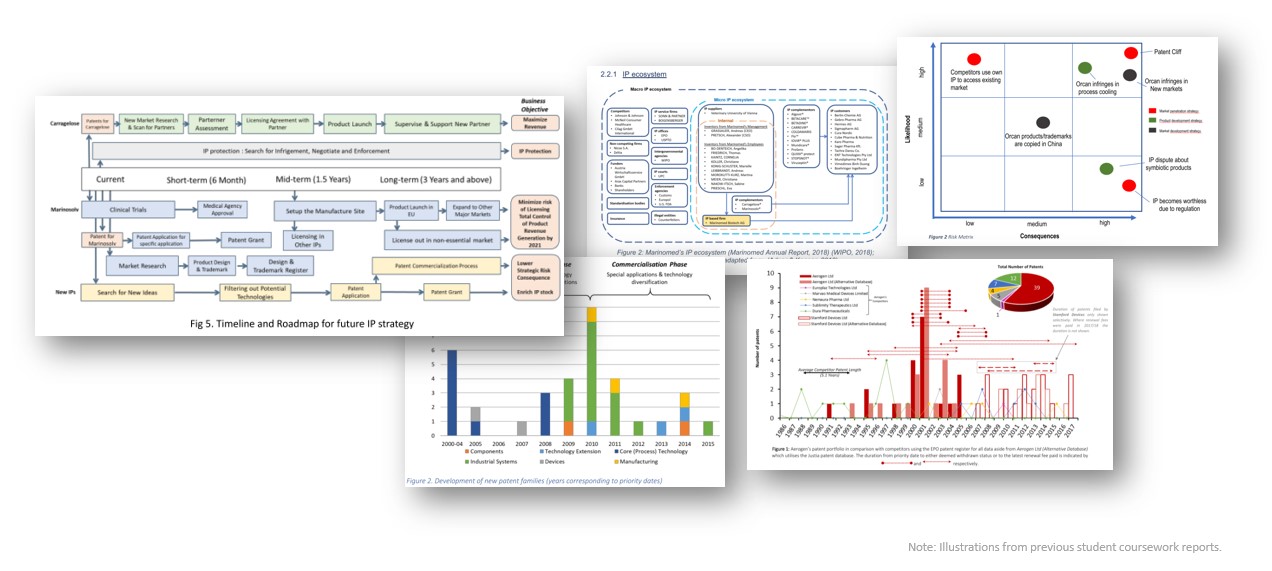
 

By definition, IP is an interdisciplinary subject. IP created by inventors, often engineers or scientists, needs to be managed and valued for decision making by executives and IP lawyers, who act within the scope of the associated legal systems. In the module we adopt an engineering management perspective on IP. Occasionally, however, we also touch on related concepts from law and economics.

During the module we run interactive, in-class exercises, talk about case examples and discuss more in-depth case studies. For instance, we look at the Dolby case study, which is a fascinating example of how a company has evolved its IP strategy over three decades along with changing technological, market and business environments to become one of the world’s most successful licensing businesses.

The module examines different approaches to IP strategies across industries. For instance, pharmaceutical companies typically rely on relatively small and focused patent portfolios, while firms in the electronics and ICT sectors typically have larger and more divers IP portfolios. For students to gain an understanding of different IP strategies in different industries, we bring in guest speakers with extensive practical experience (e.g. head of IP, vice presidents, senior IP managers) covering different industries.

Guest speakers from governmental organisations, such as the European Patent Office (EPO) and the World Intellectual Property Organisation (WIPO) join the module to help students understand the role of and functioning of IP rights systems.


-----------------------------------------------------------------------------------------------------------

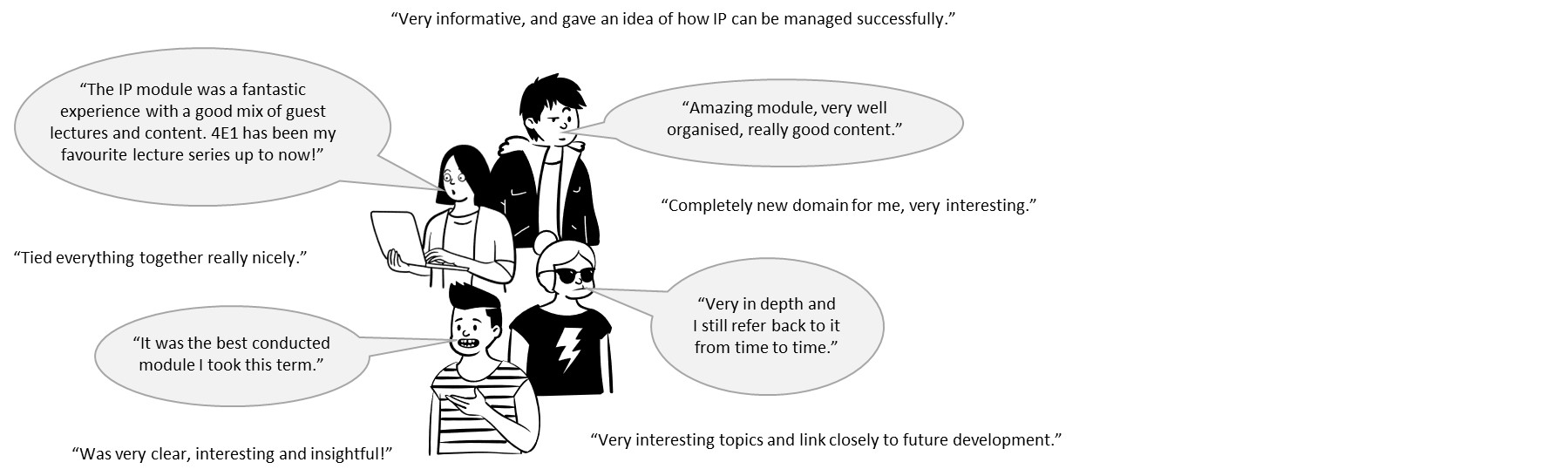
Student feedback:


Topics typically covered in this module include:


Innovation and the need for strategic IP management

  • Introduction to IP rights systems
  • Digital economy, multi-technology products and IP complexity
  • Global challenges and the need for innovation
  • The rise of open cumulative innovation, open source and the need for novel approaches to IP
  • Incentives to innovate, motives to patent, and the patenting paradox


IP systems, prosecution, litigation

  • Formal and informal IP rights (appropriability regimes)
  • Patenting features and patent quality
  • Patent procedures and renewals
  • Ownership and reassignments
  • Counterfeiting, infringement and litigation


IP analytics to support decision making

  • Patent features that are available for analysing patent data         
  • Introduction to IP analytics including free and commercial software tools
  • Patent databases, search strategies and indicators for analysing patent data (patent landscaping and mining)
  • Approaches for patent landscaping, technology foresight/ intelligence, understanding competitors and identifying emerging/ disruptive technologies
  • AI, machine and deep learning approaches for IP analytics


Technology, strategic and economic value as fundamental concepts for effective IP management 

  • The concept of value and value dimensions (strategic, economic, technological, social)
  • The value of data in the AI age
  • Established and emerging valuation approaches for IP


Markets for technology and IP licensing

  • Supply and demand sides of markets for technologies, innovations and data in the context of open innovation
  • Technology market intermediaries, e.g. non-practicing entities
  • IP ecosystems
  • Licensing models, contracts, methods to determine royalty rates, negotiations 
  • IP based business models
  • IP licensing for creating sustainable impact
  • Standard essential patents and FRAND principles


Managing IP in collaborative innovation processes 

  • Managing IP in open, collaborative and distributed innovation processes
  • Contracts and ownership considerations in collaborative R&D projects


IP risk management

  • Types of IP associated risks, e.g. reputational, operational and strategic
  • IP risk assessment process
  • Mitigation strategies to minimize IP associated risks


Developing effective IP strategies

  • How IP strategies help maximizing value creation and capture
  • IP strategy typologies
  • IP strategies for accelerating technology diffusion (e.g. patent pledges)
  • IP acquisition and exploitation/ commercialization strategies for inbound and outbound open innovation
  • Tools and toolkits for developing IP strategies


Organisational and operational aspects of IP management

  • Challenges for organizations’ IP cultures when firms move towards more effective, value driven IP management
  • Organizational principles and processes for effective IP management (e.g. incentive systems, invention disclosure)
  • IP challenges in mergers and acquisitions (e.g. due diligence, disassembly problems)


Further notes

Additional readings and resources for this module will be made available on the module’s Moodle page. Assessment details will be given at the start of the module.


Coursework

Coursework assignment 100%.

Student will have to apply the knowledge gained in this module by developing an IP strategy for a selected case company. An IP analysis of the company’s own portfolio, those of relevant current and future competitors is an important element of the coursework. Students are expected to use relevant frameworks and tools that are introduced during the module for the coursework assignment. 

Coursework Format

Due date

& marks

To develop an IP strategy for a selected case company, which includes an identification of relevant ecosystem actors, an analysis of the company’s and competitors’ IP portfolios, and the development of an IP strategy for the case company drawing upon the knowledge and tools/ approaches gained during the module. 

Further details will be available on the module's Moodle page. 

Individual report, anonymously marked

Towards the end of the module (specific date and details will be provided at the beginning of the module)


Booklists

The module mostly relies on academic articles, which will be shared with students via the module's Moodle page. 

Examples of books with relevance for this module are: 


  • Chesbrough, H. W. (2006). Open Innovation: The New Imperative for Creating and Profiting from Technology, Harvard Business Press. 

  • Contreras, J. (2022). Intellectual Property Licensing and Transactions: Theory and Practice. Cambridge: Cambridge University Press. 

  • Granstrand, O. (1999). The Economics and Management of Intellectual Property: Towards Intellectual Capitalism. Cheltenham, UK and Northampton, MA, USA, Edward Elgar Publishing. 

  • Phelps, M. and D. Kline (2009). Burning the Ships: Intellectual Property and the Transformation of Microsoft, Wiley Hoboken. 

  • O’Connell, D. (2011). Harvesting External Innovation, Gower Publishing. 

  • O’Connell, D. (2021). Intellectual Property Risk Management. Independently published. 

  • Rognstad, O. and Ørstavik I. (2021) Intellectual Property and Sustainable Markets. Cheltenham, UK: Edward Elgar Publishing.  

  • Teece, D. J. (2000). Managing Intellectual Capital: Organizational, Strategic, and Policy Dimensions, OUP Oxford. 


Examination Guidelines

Please refer to Form & conduct of the examinations.

 
Last modified: 04/06/2025 13:28

Engineering Tripos Part IIB, 4F14: Computer Systems, 2025-26

Module Leader

Prof Andrew Gee

Lecturers

Prof Andrew Gee and Prof Per Ola Kristensson

Timing and Structure

Lent Term. 12 lectures and 2 examples classes. 75% exam / 25% coursework.

Prerequisites

Part 1 Digital Circuits and Computing, including an understanding of C++ as taught in the Mars Lander project and the Part 1B Device Programming exercise. Students will be expected to write small programs in C++.

Aims

The aims of the course are to:

  • Describe the computer hardware that underlies modern information processing systems.
  • Explain how to write multithreaded software that runs on such hardware.

Objectives

As specific objectives, by the end of the course students should be able to:

  • Appreciate the basic components needed to construct a computer and the different ways to interconnect these components, including the various ways of exploiting parallelism.
  • Compare the instruction sets, implementation issues and performance of CISC and RISC architectures.
  • Design efficient hardware for computer arithmetic.
  • Understand the operation of pipelined datapaths.
  • Describe memory organisation, addressing schemes and the use of caches; and their effects on performance.
  • Compare the various ways of handling input and output in a computer system.
  • Understand the concept of a memory model.
  • Understand basic concurrency concepts.
  • Design and implement thread-safe algorithms in C++.

Content

Parallel Programming (4 lectures, Prof Per Ola Kristensson)

  • C++ memory model.
  • Race conditions, mutual exclusion, synchronization, starvation.
  • Thread-safe data structures.
  • C++ threading library.

Assessment: coursework (25%)

Computer Systems (8 lectures and 2 examples classes, Prof Andrew Gee)

  • Computer architecture, historical perspectives.
  • Instruction set architectures, RISC vs CISC.
  • ALU design, datapaths and control, pipelining.
  • Memory hierarchy, caches, virtual memory.
  • Input/output, bus organization, polling and interrupt-driven I/O, DMA.
  • Parallel processing, SIMD and MIMD architectures.

Assessment: examination (75%), candidates to attempt two questions from a choice of three

Coursework

Multithreaded programming using the C++ memory model and threading libraries. The programming exercise is an opportunity to experience how theoretical concepts from the lectures translate into actual working code using a state-of-the-art industry standard threading library. Time required: 4-8 hours programming plus 15 minutes demonstrating and discussing your code with an assessor. Please note that coursework assessment is not anonymous.

Coursework Format

Due date

& marks

Multithreaded programming

Learning objectives:

  • To gain practical experience with the C++ threading library.
  • To design and implement thread-safe data structures.
  • To practice concurrency control so as to avoid race conditions and starvation.

Individual

Demonstrating your software

Not anonymously marked

Software to be written during Lent Term

Assessment at end of Lent Term [15/60]


Booklists

Please refer to the Booklist for Part IIB Courses for references to this module, this can be found on the associated Moodle course.

Examination Guidelines

Please refer to Form & conduct of the examinations.

 
Last modified: 11/08/2025 09:14

Engineering Tripos Part IIB, 4B23: Optical Fibre Communication, 2025-26

Module Leader

Prof S J Savory

Lecturer

Prof S J Savory

Timing and Structure

Lent term. 75% exam / 25% coursework

Prerequisites

Data transmission (3F4) and Photonic technology (3B6) are useful but not essential as it is not assumed students will have taken these modules.

Aims

The aims of the course are to:

  • Provide an overview of the key technologies that underpin modern optical fibre communication systems including the appropriate theory and practice
  • Provide a system level perspective to allow progression from devices and subsystems through to systems and networks
  • Expose students to the state of the art both within industry and academia as systems move towards 1 Tbit/s per wavelength

Objectives

As specific objectives, by the end of the course students should be able to:

  • Explain the salient features of a modern optical fibre communication system employing digital coherent transceivers
  • Understand the limitations imposed by both noise and nonlinear properties of the optical fibre
  • Be able to analyse performance metrics such as signal to noise ratio and bit error rate for an optical fibre communication link
  • Understand the principles of coherent detection and the associated photonic subsystems
  • Understand the role of digital signal processing and forward error correction in modern communication systems
  • Be able to design an optical fibre communication network given appropriate constraints

Content

Optical fibre communication systems underpin modern communication systems, from the high capacity submarine cables that link continents to the interconnected mobile basestations used in wireless communications. The module will cover the theory and practice of modern optical fibre communication systems which currently achieves a capacity of 1.6 Tbit/s per wavelength. A systems approach is taken, focusing on the fundamental mathematical modelling of devices, subsystems and systems, to allow students to design and analyse future systems rather than merely reflecting latest technological developments. Nonetheless the students will be exposed to the very latest developments in the field, such as the means of transmitting 22.9 Pbit/s per fibre.

Syllabus

1.    Overview of optical fibre communication: Why use optical fibres for communication? Basic terminology (power in an optical fibre, power units, wavelength and frequency), attenuation in optical fibres, wavelength dependent refractive index (group velocity, chromatic dispersion.

2.    An optical fibre as a dielectric waveguide: From Maxwell’s equations to the Helmhotz equation, solving the Helmhotz equation in cylindrical coordinates, solving the dispersion equation for the LP modes,  modal cutoff conditions, single mode fibres (single mode criterion, Gaussian approximation for the field and its application)

3.    Propagation of pulses in a single mode optical fibre: Dispersion due to a frequency dependent refractive index, obtaining the basic linear propagation equation and its application, polarisation mode dispersion in a single mode fibre

4.    The nonlinear Schrödinger equation (NLSE): Kerr effect and its impact on transmission systems, soliton as a solution of the simplified NLSE, perturbative solution of the NLSE,  nonlinear interference power spectral density and its application to system design

5.    Noise in optical fibre communication systems: shot noise, quantum noise (photon statistics, zero-point energy), thermal noise (for both classical and quantum systems), principles of operation for the EDFA, amplified spontaneous emission (ASE) noise, noise figure and gain saturation in optical amplifiers, noise from lasers (RIN and phase noise).

6.    Introduction to optical network design: Network topology (node degree and impact on resilience), wavelength division multiplexing and the ITU grid, all optical networking and wavelength routing, reconfigurable add drop multiplexers, comparison between core and access optical networks, traffic matrices and network throughput. Overview of design exercise.

7.    Waveguide based devices: Directional couplers (coupled mode theory and its solution), coherent receivers using directional couplers including the passive quadrature network, electro-optic materials and their use for modulating light (phase modulator, Mach Zehnder modulator, Cartesian modulators, dual polarisation modulator

8.    Digital coherent transceivers: Digital signal processing (frequency domain implementation of FIR filters, adaptive equalisation), synchronisation algorithms

9.    Capacity of optical fibre communication: Advanced modulation formats including dual polarisation QPSK, 16QAM and 64QAM, forward error correction, brief summary of information theory, probablistic constellation shaping, ultimate limits  

Examples papers

Two example papers will be issued with an example class for each example paper.

Coursework

For the coursework there will be a design exercise worth 25%. Since the coursework will assess optical network design, optical network design will not be assessed in the end of year examination.


Coursework Format

Due date

& marks

[Optical Network Design]

The coursework exercise is to design an optical network to link the cities of London, Birmingham, Manchester, Leeds and Glasgow. Students are required to write a report detailing their proposed design and expected performance. Within the report three possible topologies should be compared and any assumptions made within the design should be explicitly stated.

The report should be no more than 10 sides of A4 with minimum font size of 11, however detailed calculations regarding design choices such as fibre type, amplifier spacing, launch power etc. may be included in a technical appendix that is not subject to page limits.

Learning objectives:

  • To be able to calculate the throughput of an optical network
  • To understand impact of topology on network throughput
  • To understand the design decisions and trade-offs that occur in network design

Individual Report

anonymously marked

  Wed week 9

[15/60]


Examination Guidelines

Please refer to Form & conduct of the examinations.

 
Last modified: 20/01/2026 15:54

Engineering Tripos Part IIA, 3G2: Mathematical Physiology, 2025-26

Module Leader

Prof Mate Lengyel

Lecturers

Prof Mate Lengyel, Prof A Agarwal, Dr T Savin

Lab Leader

Dr S Mandre

Timing and Structure

Lent term. 16 lectures.

Aims

The aims of the course are to:

  • introduce students to the key physiological functions that are necessary for a living organism,
  • develop a interdisciplinary analytical approach to quantitatively describe these functions,
  • provide an overview of the modelling techniques that are commonly used to understand and predict physiological processes.

Objectives

As specific objectives, by the end of the course students should be able to:

  • identify the key physiological processes at play at all relevant scales, from molecules to organisms,
  • apply physical, mechanical and chemical principles in the context of physiological processes,
  • critically discuss the validity of underlying assumptions and check their validity,
  • use mathematical and computational tools to determine and interpret model solutions.

Content

A wide variety of topics are touched upon, from biochemistry and cellular function to neural activity and respiration. In all cases, the emphasis is on finding the simplest mathematical model that describes the observations and allows us to identify the relevant physiological parameters. The models often take the form of a simple functional relationship between two variables, or a set of coupled differential equations. The course tries to show where the equations come from and lead to: what assumptions are needed and what simple and robust conclusions can be drawn.

Physical and chemical principles (4L A Kabla)

  • Molecular transport, diffusion, osmotic pressure
  • Chemical reactions, law of mass action, kinetics
  • Enzyme catalysis, Michaelis-Menten model, cooperativity.
  • Gases, partial pressures and solubility

Electrophysiology (5L)

  • Biophysical bases of cellular electrogenesis and basic ingredients of the equivalent circuit model.
  • Action potential generation in neurons: Hodgkin-Huxley model.
  • Phase plane analysis;reduced models,extension to bursting and pacemaking activity
  • Signal propagation along dendritic and axonal projections, and across chemical and electrical synapses. .

Blood Physiology (3L A Kabla)

  • Blood physiology, composition
  • Gas storage in red blood cells
  • Blood rheology, Cason equation, flow in capilleries

Physiological transport systems (4L A Kabla)

  • Circulatory system, heart, cardiac output, arterial pulse
  • Vessel compliance, pulsatile flow profile
  • Blood flow in caplliery beds, filtration
  • Respiratory system, gas exchange in the lungs, ventilation-perfusion

Coursework

Physiology of speech production. 

Learning objectives

At the end of this activity, students will be able to:

  • describe how phonation occurs in humans and how vocal folds exploit a steady flow of air from the lungs to generate steady oscillations;
  • model the movement of the vocal folds, from stating hypotheses to calculating numerical solutions;
  • use standard numerical packages to solve non-linear ordinary differential equations.
  • critically discuss the different dynamic regimes observed in the model and their significance.

Practical information:

  • Sessions will take place in the EIETL, around week 3.
  • This activity involves preliminary work (about 1h).

Full Technical Report:

Students will have the option to produce a Full Technical Report (FTR).

Booklists

Please refer to the Booklist for Part IIA Courses for references to this module, this can be found on the associated Moodle course.

Examination Guidelines

Please refer to Form & conduct of the examinations.

UK-SPEC

This syllabus contributes to the following areas of the UK-SPEC standard:

Toggle display of UK-SPEC areas.

GT1

Develop transferable skills that will be of value in a wide range of situations. These are exemplified by the Qualifications and Curriculum Authority Higher Level Key Skills and include problem solving, communication, and working with others, as well as the effective use of general IT facilities and information retrieval skills. They also include planning self-learning and improving performance, as the foundation for lifelong learning/CPD.

IA1

Apply appropriate quantitative science and engineering tools to the analysis of problems.

KU1

Demonstrate knowledge and understanding of essential facts, concepts, theories and principles of their engineering discipline, and its underpinning science and mathematics.

KU2

Have an appreciation of the wider multidisciplinary engineering context and its underlying principles.

P3

Understanding of contexts in which engineering knowledge can be applied (e.g. operations and management, technology, development, etc).

US1

A comprehensive understanding of the scientific principles of own specialisation and related disciplines.

US2

A comprehensive knowledge and understanding of mathematical and computer models relevant to the engineering discipline, and an appreciation of their limitations.

US3

An understanding of concepts from a range of areas including some outside engineering, and the ability to apply them effectively in engineering projects.

 
Last modified: 04/06/2025 13:22

Pages

Subscribe to 2025-26